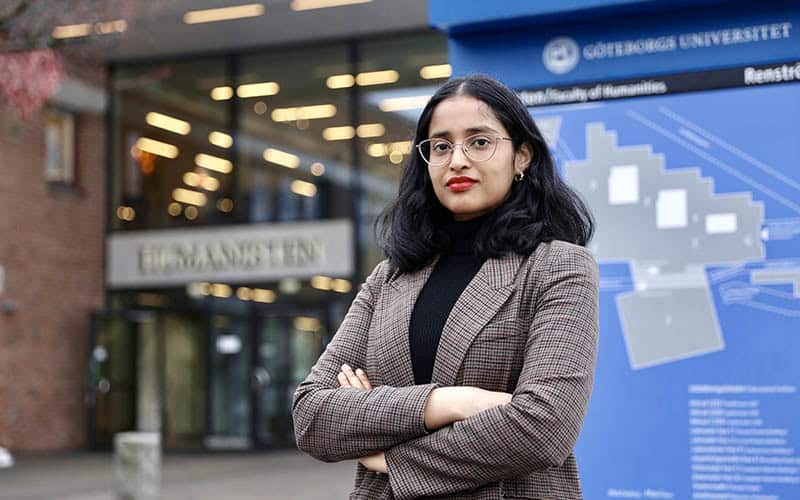
Someone who has been considering how researchers can approach the issue of AI, particularly in their academic writing, is Eva Medin, a language specialist at the communications office of the University of Borås. In her role, she works closely with doctoral students throughout their writing process. She believes that AI can help researchers to think, but it should not do their thinking for them.
“AI is a good tool, but it should be the nail, not the hammer,” she says. “I use it as a sounding board or to help me spot ambiguities and perhaps alternative interpretations.”

Eva Medin
Language specialist, University of Borås PHoto: Ida Danell
Things that should not be left to AI, she points out, are analysis, drawing conclusions and setting priorities – the aspects of a text that a person needs to be able to defend and explain. But there are ways to use artificial intelligence that do not replace your own thinking.
“AI can highlight problems rather than hiding them. Don’t ask for help to improve your text. Ask it to help you identify anything in the text might be unclear instead. Let it assess one paragraph or one sentence at a time. Is what you’ve written true? Is that exactly what you want to have in that part of the text? Then AI can identify what intellectual work remains, without doing the work for you.”
There is a lot of talk about AI being used to cheat, but Medin does not think that is the most important issue. She feels that AI could undermine the whole of academia.
“What are we here for?” she asks rhetorically. “Isn’t it to think big thoughts and come up with our own ideas? We’re supposed to be critical thinkers who contribute to the advancement of knowledge. If we don’t do the hard work ourselves, what’s the point?”
She compares this with the advice that doctoral students might receive from their supervisor or from a language expert such as herself, noting that, unlike AI, they bring an academic perspective. She says that some higher education institutions have started to cut back on language support and believes that could lead to problems.
“You lose expertise if you do that, and I think it means you’re effectively handing over your responsibility as a teacher. We now have a lot of students whose first language isn’t Swedish, and I don’t think we should put their language support in the hands of Copilot or suchlike.”
Medin emphasises that she does not believe there are only negatives when it comes to AI. It can help to make academia more inclusive, for example through translation features. But even these kinds of AI service should be used wisely.
“A translation might look perfectly reasonable, but if you’re a specialist in a subject, it makes a huge difference if a precise scientific term has been replaced with something else.”
Several higher education institutions have started up AI training programmes for their staff. One example is University West in Trollhättan, which launched a self-study course in AI in the autumn of 2025. The course is available on the institution’s website so that anyone can take it, even people outside the university.
ICT educator Maria Nilsson has been involved in designing the course. She emphasises that university teachers need to understand how AI is shaping society, so that they can adapt course content and teaching methods accordingly.
“I think the debate about AI is very important. You can’t just sit in your own little world and ponder it. You need to discuss it and examine it from every angle,” she says.

Maria Nilsson
ICT educator, University West
The course is made up of six parts, the first of which is aimed at beginners and covers how to use prompts.
“We realised quite early on that that was where a lot of people got stuck. They’ve read about AI, but they haven’t dared to use it. So that part is designed to help people get started and find the added value it can give them.”
Another theme in the course is information security. Using a traffic light model, participants learn how to approach sharing data with AI services.
“For example, approved course syllabuses, published research findings and reports get a green light, whereas information with standard security requirements, like project plans, staff lists and course evaluations before they’ve been collated, would be given a yellow light. A red light applies to things that must not be shared with AI, such as exam papers, medical certificates and tenders in procurement processes,” she explains.
University West has decided that the module on information security and a module entitled ‘AI and Generative AI’ are compulsory for all staff. In this way, says Nilsson, the higher education institution meets the requirements of the EU AI Act, a comprehensive European legal framework for artificial intelligence which is, in essence, a product safety regulation.
“The EU has identified certain uses where AI poses a high risk, and in such cases, very strict requirements are imposed on the supplier of an AI system,” explains Jeanna Åkerman, a legal advisor at the Swedish Post and Telecom Authority.
Research is exempt from the provisions of the AI regulation, but only as long as the researcher or higher education institution is not classed as a provider of an AI system.
“Research, testing and development activities relating to AI systems or AI models are exempt until they are placed on the market or put into service. If you test and use real data – real personal data, for example – then you are still subject to the regulations,” says Åkerman.
If an individual researcher uses real data, they need to be aware of the restrictions imposed by both the AI Act and the General Data Protection Regulation. She gives an example of when an individual researcher might be classed as a provider of an AI system.
“If you use a very general AI model and then make some changes so that it becomes an AI system that you have adapted for your own use, something that serves your own specific purpose, then you have become a provider. In that case, you still need to ensure that it is not a high-risk context or something that is actually prohibited under the EU AI Act.”
How AI can support the writing process
– Let AI help you with language issues rather than research issues. The closer AI gets to the parts of the work that you yourself must later be able to defend and justify, the more limited its role should be.
– Use AI to highlight problems. Don’t just ask AI to ‘improve’ your text. Instead, ask it to identify anything that is unclear, what assumptions you are making and what alternative interpretations a reader might make.
– If you ask for suggestions about a text, do so for one sentence or short paragraph at a time. Then review the suggestions critically. In this way, AI helps you to identify what intellectual work remains to be done.
Source: Eva Medin, language specialist, University of Borås