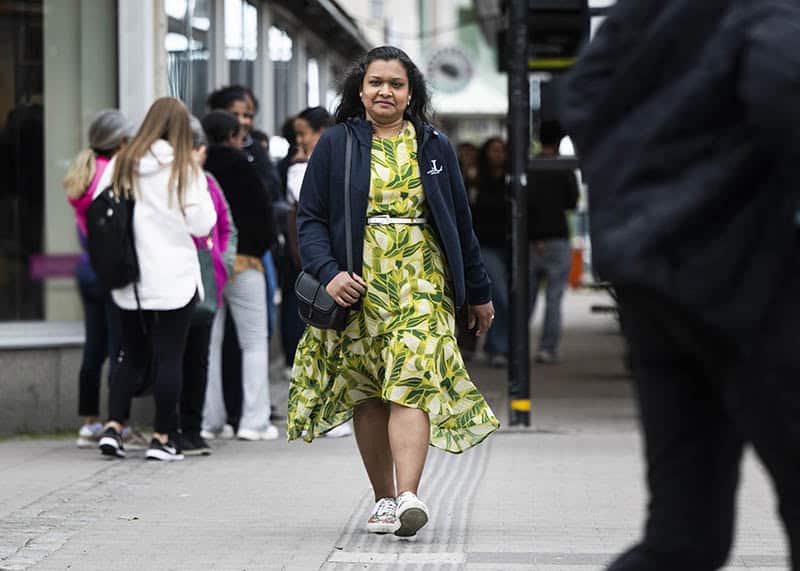
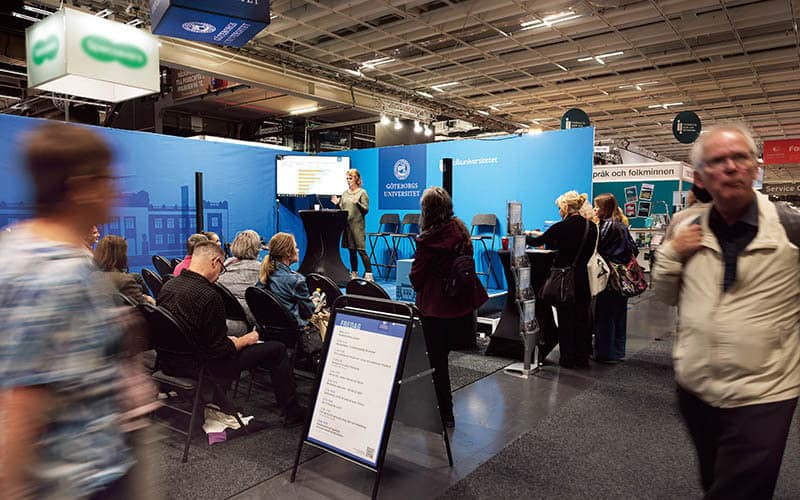
It is the second morning of the Gothenburg Book Fair. The air is not yet completely still. At least not in the exhibition hall where the University of Gothenburg has set up its open stand. The walls are painted in various shades of blue, and on the long wall is a view of the imposing university building, which is actually at Vasaplatsen. Ulrika Andersson, dressed in green, is talking about freedom of expression. Just a few metres away, the focus is entirely different: ‘When classics are given a new lease of life’. In her own presentation, drawing on the latest national SOM survey, Andersson offers new perspectives on freedom of expression. In particular, she underlines that an increasing number of Swedes believe that freedom of expression is under threat. On the other hand, many can accept the imposition of restrictions on freedom of expression, for example if necessary for national security.
She is a docent of journalism, media and communication and a researcher at the SOM Institute at the University of Gothenburg. SOM stands for Society, Opinion and Media. On the subject of freedom of expression, she is in exactly the right place to discuss it. At the Book Fair, there is literally a high ceiling of acceptance and openness. At the same time, every year, minor or major disputes flare up over who is or is not allowed to express their views here. A little later, in a slightly calmer environment, she describes enthusiastically what it feels like when the first data file containing information from the latest annual SOM survey arrives.
“It’s like Christmas. I can’t really explain it. That feeling of euphoria when I get brand new data. Everyone at work feels the same way.”
The crowds, the murmur of voices, the bustle and the constant movement of fair visitors make it challenging for the audience to stay focused. But Andersson gives the impression of being completely unfazed. After what happened at the local Pride festival about ten years ago, she can handle just about anything. She and a colleague were due to speak to a large audience at the Gothenburg Stadsteater theatre, where they were to present some findings from the Gothenburg edition of the SOM survey. The auditorium was packed, and when the presenters went on stage, they discovered that there was no screen and no projector. Andersson quickly gathered ten bottles and placed them on a table. As her colleague presented the survey results, Andersson illustrated them by moving the bottles back and forth: “40 per cent think this or that. These four bottles show that.” So if someone starts singing, it doesn’t put her off in the slightest.
“As a researcher,” she explains, “I think it’s important to be here at the Book Fair. It’s part of our third-stream activities: reaching out to give back to the community. And to be able to communicate what we see and what changes we have observed. I can’t say how we should solve this or that problem or where we will end up, but I can look at how things have been, from the past right up almost to today. Perhaps I can raise an issue or two.”
She enjoys being able to put questions to a large group of people, seeing how different groups relate to one another, comparing them with one another, and then observing how these things change over time. She likes quantitative surveys, figures, data.
“With the help of these figures, we can say something about the world around us and the present day. It’s a very rough picture, of course, and not everyone will recognise themselves in it. But it can still be largely accurate.”
She frowns as she ponders what it is that makes her job so enjoyable. Actually, she concludes after a moment or two, it is formulating questions and, well, the entire research process from start to finish. She also stresses how grateful she is that so many people respond to the SOM Institute’s questions, despite the survey questionnaires being quite extensive. She also likes the workplace itself, which she describes as a safe space where everyone both “has the support of everyone else and supports everyone else”.
“I know that the deputy chief analysts feel there is a hierarchy. But I compare it to working at a university department, where there is an extremely clear hierarchy between different staff groups. Everyone is needed, and even though there are relatively few of us, there are twice as many of us as there were ten years ago.”

A lot has happened since the SOM Institute was set up in 1986 by Sören Holmberg, Lennart Weibull and Lennart Nilsson. There are now six PhD-qualified researchers, two survey managers, several deputy chief analysts, a communications coordinator and an administrator. Andersson believes it has grown at just the right pace.
When she was young, she dreamt of becoming a journalist, a writer or a researcher, and from an early age she produced her own newspapers and conducted her own surveys with as few as five respondents. She says she found her calling when she started university and speaks fondly of researching, describing and analysing.
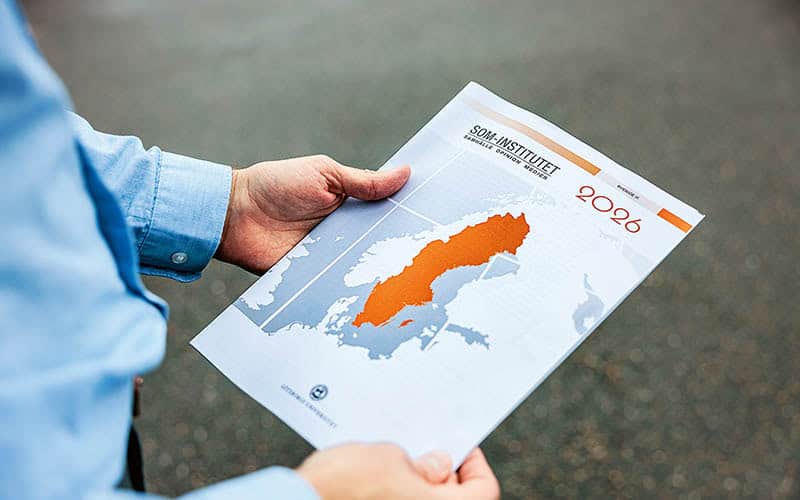
The SOM surveys have been conducted every autumn since 1986. Questionnaires focusing on various aspects of society are sent out by post to randomly selected people throughout Sweden. This year’s edition – or rather, editions – has just been sent out to a total of 45,000 Swedes. First, the recipients received a card to say the questionnaire was on its way, and then everyone received an envelope containing the survey a week later.
The SOM Institute is based in another part of Gothenburg, five floors up in the Mediehuset building, a stone’s throw from Linnéplatsen. Formally, the independent research organisation is part of the Department of Journalism, Media and Communication (JMG). In a rectangular meeting room, the moustachioed Daniel Jansson shows us some slides “with a few trends and graphs”, as he puts it. He is the institute’s communications coordinator, and today he has brought his daughter to work with him. He has been working here for ten years, and previously worked in a department that works with infrastructure, the Swedish National Data Service (SND). At that time, he was working with data from the SOM Institute and other sources. When he first joined the SOM Institute, he was a deputy chief analyst with some responsibility for communications, and as the organisation has grown and been restructured, his role has been refined.
Jansson tells us about the Swedish Citizen Panel, an online panel in which 70,000 people answer questions regularly throughout the year. This makes it possible to track individuals over time, to experiment with different types of questionnaire design and, not least, to tailor the research to make it a little more specific and focused. He says that the two major projects complement one another. Using the SOM surveys, they can analyse Sweden, the Swedish people and the population as a whole, while they can use Citizen Panel to ask specific questions of particular groups, such as university teachers or new parents. Half of all operational staff at the SOM Institute work with the panel and half work with the SOM surveys. They also conduct other surveys, including the Pep report in collaboration with Generation Pep, a non-profit organisation focused on active and healthy lives for children and young people.
The institute’s flagship survey, the SOM survey, is carried out every autumn to ensure the best possible year-on-year comparison. It is particularly important that it is conducted after the elections in election years. The SOM Institute does not work alone on the survey, but collaborates with many researchers on various projects at higher education institutions across the country. State authorities and public sector organisations are also involved, funding some parts of the survey. This enables them to send their questions to the random and representative sample that receives the questionnaires. The SOM survey is generally conducted in three different versions: the national survey, one for western Sweden and one for Gothenburg. Parts of the questionnaire cover background factors, such as living arrangements, life satisfaction and political leanings.
“Through repeated reminders during the autumn, we reach a great many people,” says Jansson, “and this also ensures a better distribution of respondents. Certain high-response groups reply as soon as they receive the survey. But the long fieldwork period means we also reach many younger men, who are generally a little harder to get responses from.”
This approach, sending out questionnaires and reminders by post, is costly, but the aim is to reach as many of the randomly selected respondents as possible in order to give them the opportunity to make their voices heard. The next stage is to use the figures and data to form the basis for decision-making by heads of state authorities, civil servants or politicians. They are used in government reports (SOUs) and in research. Around 50 per cent of those randomly selected from the population register complete the survey. This has been the case for the past ten years, and the SOM Institute is happy with this response rate.
However, compared with the early days of the survey, significantly fewer people respond nowadays. In the 1990s, the response rate could be as high as 70 per cent. This remained the case up until the turn of the millennium, and from 2010 onwards the response rate began to fall further. There is now more competition for Swedes’ attention, and our constant digital activity means that the value of a survey on society like that conducted by the SOM Institute has declined in the eyes of many people. At least, that is what Jansson believes. The SOM survey is conducted in Swedish only, which also affects the response rate. Furthermore, changes in postal services have played a part, as well as demographic shifts. However, in comparable surveys in other countries, such as those in the United States, a response rate of around ten per cent is seen as more normal.
Annika Bergström, the Director, is dressed in a light-coloured, striped shirt when we meet her. She supports the football team Östers IF from the town of Växjö, but she was actually born and raised in Vetlanda. She wants the SOM Institute to deliver high-quality survey-based research, to lead the way in the development of survey methods, and to share the results of that work.
As early as 1991, she worked with coding the open-ended responses in the SOM survey, and since then she has been involved as a collaborating researcher, from the mid-1990s right up to the present day. Between 2010 and 2017 she was a survey manager, and she has been the director since 2023. She is also both a professor and director of studies at the Department of Journalism, Media and Communication.
“What we do is relevant, reaches a large audience and is widely used. It also feels important that our work can reach a somewhat bigger audience than my own research project, which perhaps has greater exposure within academia and the scientific community. I like being part of something with a broader perspective,” she says.
The SOM Institute aims to have strong presence and visibility in Swedish public debate, and she believes this is important because the institute is publicly funded, receiving both core funding from the University of Gothenburg and collaboration grants from its many partners. And the organisations with which it collaborates are also almost exclusively publicly funded. At the same time, it is important to be able to contribute some form of fact-based information to the public debate – information based on the wide-ranging data collected by the SOM Institute.
“Yes, those are probably the strongest arguments. Being able to give back, but also to provide data and statistics in various situations,” she notes.
Like Daniel Jansson, she finds it regrettable that the response rate is no longer what it was in the 1990s. However, she says, things have become more difficult for everyone who works with this type of survey, and they have tried many things in their efforts to discover how people can be encouraged to respond in greater numbers. They have tested different approaches, from changing the wording and tone of the correspondence and questions to different incentives and rewards, such as lottery tickets and sweets.
“But that’s no reason to stop conducting the surveys. As long as we know that we’re basing our conclusions on the roughly 52 per cent response rate we have now. We carry out rigorous analyses so that we can reliably identify which groups don’t respond. So I believe we should continue to survey the Swedish population.”
When the institute presents the SOM survey – or surveys – it generates significant media coverage, and she feels that the media generally do a good job of reporting on the content and findings, often referring to the institute and the survey accurately. Perhaps, she muses, there could be more discussion about margins of error and the issues surrounding the figures. They shouldn’t be taken too literally or viewed as something exact or absolute. The figures are not precise measures of reality, but rather estimates. Otherwise, it would be necessary for absolutely every Swede both to be sent the questions and to answer them.
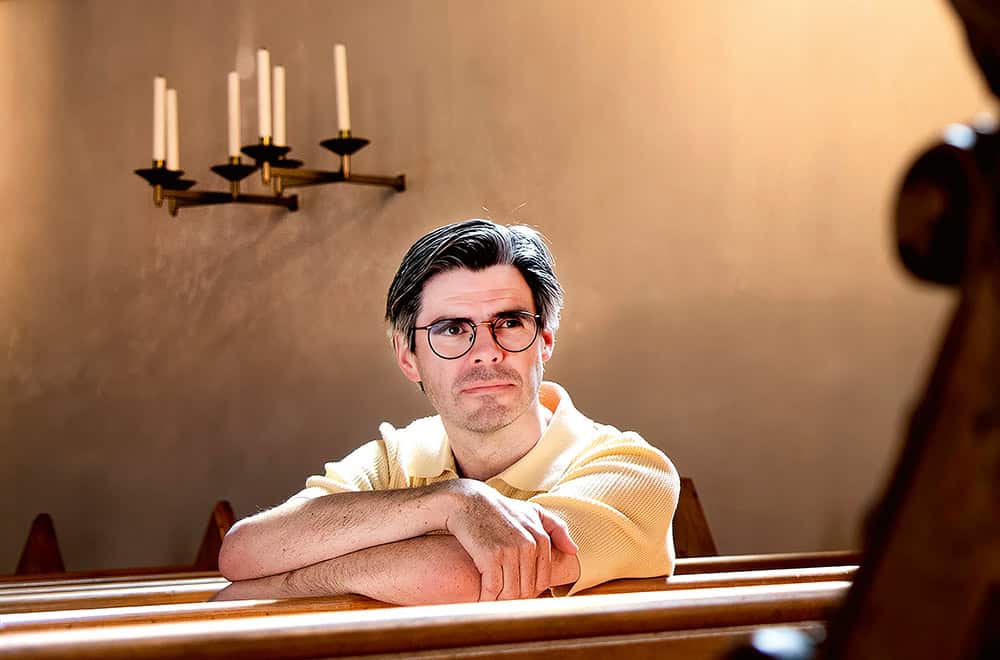
In this context, survey manager Marcus Weissenbilder, wearing a smart light blue shirt tucked into his dark suit trousers when we interview him, is the newcomer, even though he has been working at the SOM Institute for nine years. He started out as a research assistant, transcribing the answers to the open-ended questions based on coding schemes.
“When I applied for the job here, Henrik Ekengren Oscarsson was still the director. Every four years at election time, you’d see him and Sören Holmberg, a senior professor and senior researcher at the University of Gothenburg’s Department of Political Science and one of the founders of the institute, on TV. They were familiar faces. Everyone in political science in Sweden knows about the SOM Institute and the research programme, and I’m interested in Swedish politics. It was Henrik who interviewed me and hired me, and then just a couple of weeks later, there was a new director, Johan Martinsson, and nobody had told me anything about that,” he says with a smile.
As he sees it, the most important thing about the SOM Institute is that it is an independent, researcher-led, non-profit organisation. Everything they do is public and transparent; it’s easy for people to scrutinise the figures and statistics if they wish. You need to be able to trust the findings.
“The private opinion polling organisations look at what we do. They use our questions and our methods. We carry out a lot of methodological research, and that also improves their work. Funding us is a good use of taxpayers’ money. We provide a lot of value for every tax krona.”
Less than two weeks have passed since the parliamentary election when we meet, and the debate over opinion polls has not yet died down. One poll showed this, another showed that, and so it went on until the polling stations closed. Weissenbilder believes that the problem is not the polls themselves, but how they are presented in the media. He argues that they need to be made ‘less sexy’. Newspapers, television and radio need to show more – more figures, more details, more information. How many people responded? What are the margins of error?
He also defends the exit poll presented on election night by the public service television broadcaster SVT, for which Henrik Ekengren Oscarsson was responsible. The poll was simply not designed to summarise differences between the political blocks in the way it was presented, and SVT should have made that clearer.
“But there is nothing wrong or bad about the poll itself,” he says. “It is still by far the best election-day survey we have in Sweden.”
At the SOM Institute, the day-to-day work of the survey continues as usual. Weissenbilder and five colleagues share responsibility for the telephone number people can call to ask questions, opt out or complain about the numerous letters and reminders.
“It should be as easy as possible for people to opt out of the survey if they wish,” he says, “but it’s also important for us to know why participants are unable or unwilling to take part. Last week, a woman rang and said she didn’t trust any Swedish universities because they’re so left-wing. I tried to explain who we are, what we do and how our results are used. In the end, she changed her mind and actually agreed to complete the questionnaire.”

The SOM Institute
SOM stands for society, opinion and media. The SOM Institute is an independent research organisation at the University of Gothenburg. It was founded in 1986 by Sören Holmberg, Lennart Weibull and Lennart Nilsson. The institute conducts its own societal and methodological research, but also puts research questions to the general public or to participants in online panels. The SOM Institute primarily carries out two major surveys each year: the SOM Survey and the Citizen Panel.
The SOM Surveys
Every autumn since 1986, the SOM Surveys have been conducted in three versions: a national survey, a regional one and one that is conducted in Gothenburg. This year’s surveys were sent out by post to a total of 45,000 Swedes. The questions cover everything from politics and the media to topics such as lifestyle, health and leisure habits.
The survey’s results are widely used in both research and public debate. Every year, a number of reports and presentations based on the national SOM survey are published. This year’s survey, like those in all election years, is regarded by the institute as particularly important, as it enables analysis of the factors behind the election result and how different groups voted.