Joel Halldorf has just appeared on the morning show on Swedish Radio’s P3 channel and is now just a few minutes’ walk from the studios in Stockholm. It is not far from the building which houses Swedish public service television. Seated at the next table at the outdoor café are the well-known television journalists Anders Holmberg and Camilla Kvartoft. He says hello and has a quick chat before heading back. He lives just outside Linköping, the town where he grew up, but commutes to Stockholm.
“I’m quite good at logistics,” he says. “You have to be able to juggle things. When you’ve got too much going on at once, that’s when you start to lose track and miss or forget things. But it’s fun. There’s also plenty of variation when you have both the university’s slower processes and in-depth work and then the radio, which is a bit faster-paced and where you can get away with some simplification.”
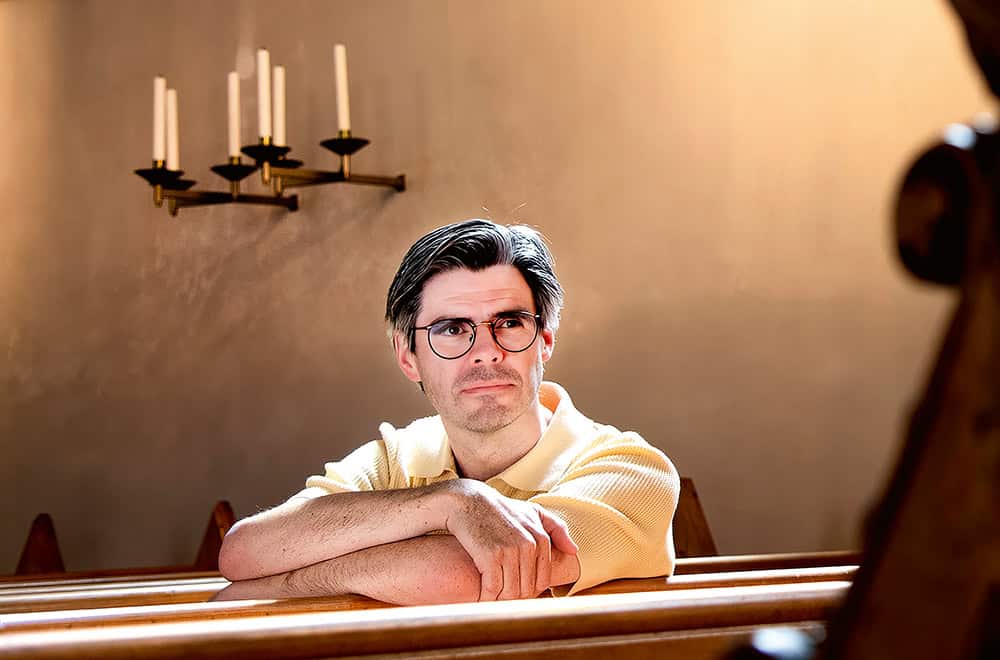
He speaks Swedish with a clear but not extremely broad Östergötland accent. He is wearing a yellow polo shirt, and his tidily wavy hair is streaked with grey. Halldorf has been a professor of church history at University College Stockholm (EHS) since 2021. His latest book, Makten och det heliga: den religiösa vändningen i världspolitiken, (Power and the Sacred: The Religious Turn in World Politics), was published this spring. The Christian daily newspaper Dagen wrote at the time that “Halldorf is probably our foremost contemporary educator when it comes to explaining the long-term and broad trends in the relationship between religion and politics”.
He may be an educator, but he is also a fearless debater who hosts podcasts and writes regularly for the culture section of the Swedish tabloid newspaper Expressen.
One of the reasons he is seen and heard ‘everywhere’ is that his range of subjects is reminiscent of that of the journalist, author and poet Göran Greider. That is roughly where the similarities between them end. Or perhaps they do not, as both weave together their many different interests and worlds, demonstrating that everything is interconnected. They both also have the ability to explain things clearly and make what they are talking about easy to understand. They certainly display no lack of self-confidence either, even though they both possess an enviable talent for always coming across as humble and attentive listeners.
Halldorf elaborates on his thoughts about being interviewed in contexts such as on P3, a national public service radio channel focusing mainly on pop music, popular culture and social journalism, and draws parallels with the classroom. On the radio, just as in a lecture setting, it is crucial to be pedagogical and focus on ensuring that what he says is easy to understand. He has been teaching at university since 2009 and completed his PhD three years later. He emphasises that he identifies strongly as a teacher, and if anyone asks what he does for a living, that is what he answers.
“I love helping people to understand the world, providing perspective and historical background – that piece of the jigsaw puzzle that makes your face light up and you just say ‘Oh, now I get it’.”
Learning something is one of the most enjoyable things you can do, he believes, and imparting knowledge yourself gives you the same feeling. Even back when he was at school, he enjoyed helping others. Many of his classmates sought Halldorf’s help in the run-up to exams, and they could sit for hours. Now, many years later, he sees the similarities between being interviewed on the radio and those moments. The only real difference is that he now reaches a wider audience. He enjoys being seen and listened to and explains that he comes from a family of pastors, with his father and grandfather having always been ‘on the stage’.
After a while, he points out that he is not a perfectionist. It is more a question of understanding the context, in relation to the previous discussion about simplification. You cannot say everything you know every time you open your mouth.
The Relationship between religion and modern society
Joel Halldorf’s primary research interests centre on the relationship between religion and modern society. This is also the subject he focuses on when writing opinion pieces or speaking to the media. It is not uncommon for him to discuss religion and politics, such as the fact that in recent years it has become increasingly common for right-wing politicians to flirt with Christianity in the United States, in Russia and also in Sweden.
The young Joel Halldorf dreamt of being a teacher, but in those days, it was secondary school or upper-secondary level that beckoned. University was, as he puts it, a mysterious world. He is not from a family of academics. But the craft of teaching, the role of the teacher, appealed to him. He has always loved writing and says it is the only form of creative expression available to him. He is not musical and he cannot paint, but writing channels his creativity. It is hard work of course. That too. But when the words flow, that is when he is in his element; that is when he feels good.
“We moved to the United States, and I went to college there,” he says. “I came from a free church background where people were sceptical about higher education in the humanities, especially theology. It was as if studying would erode your faith. Although I didn’t see it that way, I had to overcome that obstacle in the mindset I had from my upbringing.”
At college, one of the subjects he studied was religion, and he found that by far the most enjoyable. When he moved back to Sweden, he continued on that path, first at Linköping University and then in Lund, before completing his doctorate in Uppsala. Now he says that it was refreshing to encounter scientific methods and perspectives applied to the Christian faith, and to have opportunities to engage with it in a concrete manner.
He talks about his belief that the debate on religion in Sweden is largely about wild guesses and rumours flying around. Some say that Jesus never existed, and there are plenty of conspiracy theories – not least when the book and film The Da Vinci Code were at the height of their popularity in the early 2000s. For Halldorf, it was important to process what he had learnt with the help of science and academia. It was part of his own religious maturation. His personal development also required him to come to terms with certain beliefs and ideas.
“Such as learning to see oneself as the result of historical processes, both as an individual and as a church. It is not something that has simply fallen out of the sky, ready-made. There is history behind it, and with that come power struggles and politics. The history of the Church is full of both saints and sinners. Brutal things have happened. But we modern people tend to be a little out of touch with history in the way we view ourselves.”
He simply goes about his business, developing his ideas through lengthy and methodical examples. People today believe that a person’s life is the result of the decisions they have made. He argues that we fail to see how much of our values, our culture and our life choices are the product of “a historical lineage, of which we happen to be the latest offshoot – not in a deterministic way, but nevertheless very much shaped by it”.
That is how he works and how he thinks; and that is where he ends up – in the belief that it is important for him to explain the present with the aid of a historical perspective.
“I’m of the opinion that you understand yourself, your era and your context better if you understand its history. And that very much reflects my own experience. I remember when I was reading about the history of the free churches and the revivalist movement, and I realised that the reason that emotions were so important in the congregation I grew up in was to do with a movement, namely 18th-century Pietism, which emphasised the heart and personal devoutness.”
That was when he understood. That was when it became easier for him to relate to his own faith and his own congregation.
He felt at home in academia straight away and says that, as he puts it, is happier when the standards of education are pushed higher. But things can get a bit stiff, he thinks. Like being in a knowledge factory. He has worked his way through Linköping, Lund and Uppsala universities and now works at a considerably smaller workplace and a considerably less well-known higher education institution, University College Stockholm.
“I don’t like large institutions,” he says. “I prefer them to be small and close-knit. Many of my best friends are at large universities, and I’m happy to go there and visit them, but I find it difficult to navigate large institutions.”

Halldorf reflects on the congregation in which he grew up, where the congregation was everything, the centre of everyone’s life, and where there is a deep understanding of entrepreneurial spirit. The distance between the pastor and the members of the congregation is small. As a member, you can shape your own environment. At Uppsala University, for example, the situation is completely different. Nothing can be resolved through a quick negotiation – not the course descriptions, not the course literature, not the timetable. That is how he sees it. Instead, he speaks gently about how much he appreciates being at a smaller university, where you know all your colleagues, learn the students’ names and know where they are in their studies. You can talk to the timetable coordinator.
“My life is hectic. I commute and have other commitments, so I need that sort of flexibility within an institution. I like it, and that also reflects the fact that I’m a free church kid. We’re good at small communities, not at large institutions.”
He adds that people in the Church of Sweden are much better at precisely that – at functioning and working within a larger context. University College Stockholm is not one of those, I say, and tucked into a question I mention that Joel Halldorf is better known than his school. He smiles and says that he has heard something along those lines before. In his pedagogical manner, he explains the school’s background within the Swedish free church movement. It offers both research and higher education, but it is teaching that takes centre stage, and the institution has around twenty teachers and a couple of hundred students.

In the classroom, (and in the world outside), Joel Halldorf tries to spark discussions, dialogues. He emphasises the importance of being attuned to what is happening and being said in the room. That is also evident during our interview. At its best, an interview is like a discussion, ebbing and flowing a little, with room for a little uncertainty and excitement amid the clarity. That is what is happening in our conversation here, surrounded by Karlavägen’s brutalist architecture.
When he is not working, Halldorf watches a lot of football. It is his favourite pastime. The Arsenal fan’s eyes sparkle as he talks about it, before noting that his two children are now so big that he has to beg for their attention. He finds cleaning and cooking relaxing.
“My wife leads a very extroverted life. She runs a cultural café, so she meets half of the population of Linköping during her working day. I sit and write. So I enjoy meeting people. I’m never more relaxed and present than when I get to meet friends.”
So you don’t you get tired of people, given your role as a teacher and all the debates you take part in?
“I don’t teach enough to get tired of people. And the debating all gets so abstract. The lovely thing about talking to someone is that you don’t even wonder what’s making that pinging sound on your phone. You’re truly in the here and now, removed from the media.”
Halldorf gets in touch after the interview. He has been thinking about what he said when we met and how he phrased things. The best insight, he says, is that when answering questions from the media, you shouldn’t ask yourself, ‘Am I the best Swedish researcher on this topic?’ but rather, ‘Would I be able to teach this?’
Joel Halldorf…
… is 46 years old and lives on the outskirts of Linköping, where he also grew up. He is married to Lydia Halldorf, and they have two children. His father, Peter, and his grandfather, Samuel, were pastors in the Pentecostal movement. Both Peter and Joel Halldorf have since left the movement, and Joel is now active in several religious communities, primarily the Church of Sweden and the Catholic Church. He obtained his doctorate from Uppsala University in 2012 with a thesis on the preacher and hymn writer Emil Gustafson. In 2021, Halldorf became a professor of church history at University College Stockholm (EHS). He is also an author and regular commentator in the media, writing for a range of publications including the tabloid daily newspaper Expressen. This spring saw the publication of his latest book, Makten och det heliga: den religiösa vändningen i världspolitiken, (Power and the Sacred: The Religious Turn in World Politics).