Kristianstad is a city undergoing change. In 2029, the university is set to move into new premises in the heart of the city. But for now, that place is just a building site where part of the Galleria Boulevard shopping centre used to stand. Lisa Källström and her colleagues are still working at the old regimental barracks area at Näsby in the north-western part of the town. She reports cheerfully that her commute to work takes just five minutes.
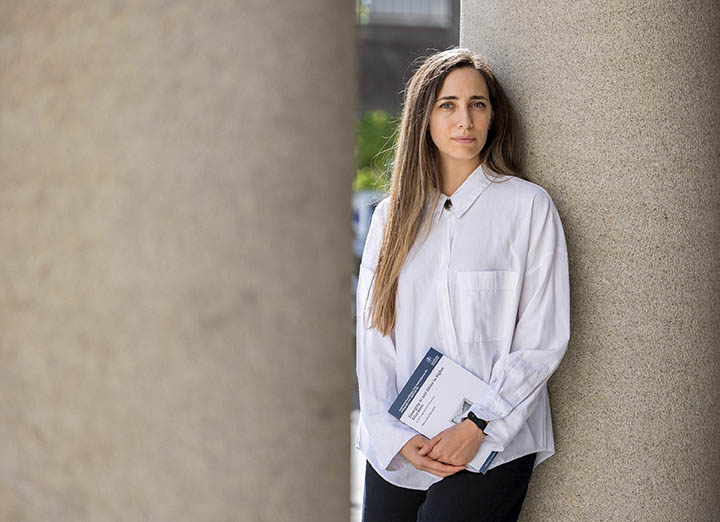
The vibrant red of the changing autumn leaves complements her burgundy-coloured blouse perfectly. Her refined yet distinct accent gives her away as hailing from the area around Kristianstad and Hässleholm (Sösdala). She is standing outside the library building, which also houses the café, talking about what will happen to the buildings when the university moves out. There are plenty of different options.
She has spent more than half her life in these grand corridors. She has been employed here in various roles since 2004, and before that she was a student here, studying business.
“I was quite young when I started, straight after school,” she explains. “Back then, it wasn’t really a passion or a dream, but just a broad education that could lead to jobs just about anywhere. I thought marketing was interesting and, well, I didn’t really give it much more thought than that. But I like this world and I enjoy being in a place where people focus on knowledge and development.”
When Källström has filled her coffee flask and we are walking up the stairs, she tells us that opinions differ on how cosy the premises are. The high ceilings create a different sort of atmosphere to the one that they will work in after the move. There is undoubtedly a certain charm in the fact that not every centimetre is optimised, she herself thinks. On the low, round table just inside her office door lie a few piles of paper that must not be moved or disturbed – that’s how important they are. The planning board above exudes creativity. She has written ‘Place attractiveness’ at the top, and then some headings with a number of points below each: Project, Output, Forum and Status.
Her mother often tells her that she thinks her job suits her very well. For example her love of planning, of ticking things off in her diary – she started doing that when she was young. Källström agrees and says that, as an associate professor, she has a fun and varied job. She sees teaching, research and collaboration as all equally enjoyable.
“I’m quite an inquisitive person by nature, curious about what other people think and feel,” she says. “I suppose that’s linked to the fact that I enjoy teaching, because it involves interacting with students, and for you to be able to learn something from me, I need to understand what you already know and what your frames of reference are. It also becomes a kind of collaborative encounter between the students and me as the teacher.”
Over time, she realised how much she liked the academic world and that she wanted to do a doctorate. She was on parental leave when “a PhD project came along that was about place”. The local authorities in north-eastern Skåne were interested in a project in which Kristianstad and Hässleholm were described as engines for growth and which centred on place. Lisa jumped at the chance and has continued to focus on place branding and building attractive places since then. Sometimes something starts for a particular reason and then it grows, as she puts it.
“Everyone has a connection to their place, and I do enjoy doing things together with others. When different people’s perspectives come together and form something new, that’s the foundation of how you develop a place,” she explains.
“Then again, it’s hard to know whether I enjoy collaboration and co-creation because I’ve studied place so much, or whether I study place because I enjoy co-creation and collaboration. I think that collaboration is the foundation in some way, and place is the object of study.”
If it’s possible to be both calm and energetic at the same time, then Lisa Källström is just that. She chooses her words with great care, yet also gives a, well, lively impression. Things can happen.
Has her own view of her place, of Kristianstad and the surrounding area, changed as a result of her devoting so much time to reflecting on place? Yes, probably, she explains. Perhaps the average person does not think all that much about the place where they live. They are happy there, hopefully, and that is fine. But the more she studies place and the phenomenon of place, the more obvious the complexity of what makes people like the place where they live becomes. Tiny, tiny things can be significant in making a person feel happy about where they are.
“And the importance of the people you interact with, in order to like where you are. I often hear people ask things like ‘What should we do to make our place more attractive?’ You can certainly build up attractiveness to a certain extent. You can beautify the town centre, clear away rubbish and dirt. That’s obviously one piece of the jigsaw. But the diversity itself, the sense of inclusion and co-creation with the people who live there are still what really stand out.”
Her research focuses on place branding and the co-creation of value in various contexts. She believes that municipalities and regions are becoming increasingly aware of the importance of marketing their local areas, and as this happens, they also gain a greater understanding of how it should be done. She explains that this goes hand in hand with the fact that many municipalities are losing residents rather than gaining them, and that competition is becoming fiercer when it comes to attracting both individuals and businesses to move to a town. She also talks about target audiences and how it is easy for a municipality or region to think in terms of a destination, of results, that people should want to move to Kristianstad, for example, or want to visit the town.
Källström believes that the key is an attractive place and a strong place brand for the people who live there. Perhaps not many people have thought about starting at that end, she muses.
“If the place is attractive to those of us who live in the town or community, then we also become integral to marketing it. Generally speaking,” she emphasises, “I think people have realised that it’s as much about what we offer in the place as it is about how we’re perceived and the stories we collectively tell about the place.”
She talks about where she lives and works as an example. She says the local authorities in north-eastern Skåne are well aware of the importance of competing against ‘the other side of Skåne’ – the metropolitan area around Malmö and Lund. This means knowing what is unique about this part of the country, what the advantages are and how to communicate them. It is all interconnected. Obviously it is important that education, healthcare and social care function properly, but as people become more mobile and move more frequently, it is vital not to take residents for granted.
“My research has probably opened my eyes to the unique qualities that the place where I live and work has to offer. I’ve become more aware of what we have and what we don’t have. Above all, I’ve become aware of how people talk about their local area, their place. What feelings do they convey about the place? What do they bring up when they talk about a place? It’s fascinating.”
Over the years, she has been involved in several different projects in north-eastern Skåne. One such project is in Östra Göinge, about which she and her colleagues are now writing a chapter for an anthology on collaborative research. There, they developed the place brand ‘The Green Heart of Skåne’. Another ongoing project is for the municipality of Hässleholm, where she herself grew up and went to upper-secondary school. There too, the aim is to build up and strengthen the place brand and identify the stories that are unique to Hässleholm.
For a time, Hässleholm lobbied for the university to change municipalities and move 30 kilometres north. Källström admits that the whole affair has been a little special for her.
“But I don’t know if the move ever felt like a realistic prospect, or if it was just part of the strategy and the negotiation. I don’t know how close it came to happening. And the idea of Kristianstad University being anywhere other than in Kristianstad does feel a bit odd. But we are definitely the university for the whole of north-eastern Skåne. We serve the whole area.”
On the subject of dividing her working time roughly equally between research, external collaboration and teaching, she is clear that she wants to have all the pieces of the puzzle in her job. Since completing her doctorate in 2019, she has continued to focus on the subject of place in various ways, and says rather dramatically – with a wry smile – that she would feel handicapped if she was not able to combine research with teaching.
Time and again during our conversation, she returns to the topic of collaboration. But what exactly does she mean by it?
“I have a lovely researcher’s answer to that question. Because it’s not just one thing. We – my colleague Elin Smith and I – have developed a framework to describe it. It can involve everything from openness and keeping each other informed along the way to truly having a shared influence and actually creating something together. But collaboration and co-creation aren’t the solution to everything. It’s when an issue or a challenge benefits from having multiple perspectives that you should collaborate,” she explains.
One of the projects on the board in her room is about the town of Kristianstad and what it tastes like, (and smells like, and how it makes us feel). For instance, a wine and a cheese have been selected that are supposed to ‘taste like Kristianstad’. This is one of many examples of how the focus of the discussion on place branding has shifted, from logos to embodying the experience of a place. Sensory experiences in a place contribute to our stories about it.
At the time of writing, Lisa Källström is soon to attend a conference in Portugal, where she will present her research on this topic – that a city and a place are everything all at once: emotions, flavours, scents and smells. She is looking forward to the trip, as she loves to travel. We talk about the importance of planning when, like her, you have three sporty daughters and a dog, a miniature schnauzer called Doris.
“That’s the only downside to my job. We’re not allowed to have dogs here. I was at a writers’ retreat recently, and Doris was there with me for two days. It was brilliant!”

Lisa Källström
… is 45 years old and lives in Kristianstad. She grew up in Sösdala in the neighbouring municipality of Hässleholm. She is married to Jimmy Källström and they have three daughters. Her and her family’s leisure time revolves largely around sport – basketball, handball and football.
She is a docent and associate professor of business administration, specialising in marketing, at Kristianstad University. She is also a recognised university teacher.
Place attractiveness and co-creation
A strong brand makes a place more attractive, both for residents and visitors. But how do we actually create a brand for a place? In many ways, that is what Lisa Källström’s research is all about. Attractiveness can refer to what a place has, but also to what it does not have – things like heavy traffic, congestion and noise.