The European Council of Doctoral Candidates and Junior Researchers (Eurodoc) recently published figures on salaries for doctoral candidates in Europe. Denmark tops the list, followed by Germany and Belgium. Sweden ranks 9th out of the 26 countries in the survey.
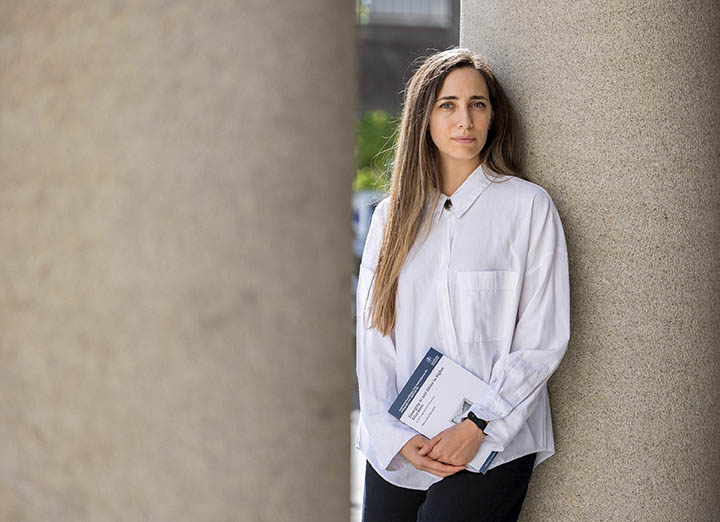
Haro de Grauw sits on SULF’s Association Board and is the union’s doctoral candidate representative at Lund University. He believes that the pay situation for doctoral candidates in Sweden is serious.
“Many doctoral candidates feel that their salaries have not kept up with the cost of living,” he says. “There is a widespread perception among international doctoral candidates applying to study in Sweden that the financial conditions are good. In reality, however, this is not really the case.”
In many European countries, doctoral candidates’ salaries are the same across the whole country. However, Swedish doctoral candidate salaries vary between higher education institutions, and also between research disciplines. In its survey, Eurodoc has based its figures on Sweden’s pay level on doctoral candidate salaries at Stockholm University and the Royal Institute of Technology (KTH). The average of these two is SEK 32,650 kronor. According to SULF’s salary statistics from 2025, the average salary for doctoral candidate members across the country is SEK 34,540 kronor. In de Grauw’s view, that one reason for the differences within higher education institutions and between different subject areas is that certain professional categories are more highly sought-after in the labour market.
Although Sweden has a higher research budget than many other countries, this does not necessarily mean we have higher doctoral candidate salaries, he says. It depends on what proportion of university funding is actually spent on doctoral candidate salaries and how many doctoral candidates there are in the country.
“Many people think it’s great to be paid for doing a doctorate until they begin to understand the cost of living situation.”
He points out that there is fierce competition for funding. There is also considerable pressure on professors to ensure that the money is used as efficiently as possible.
“In several disciplines, it’s becoming increasingly difficult to recruit Swedish doctoral candidates. So they take in international doctoral candidates because there’s always someone who’ll accept the offer, regardless of the salary.”
On the subject of whether salaries for doctoral candidates in Sweden are reasonable, he says “If you have a partner who works or if you are single, it’s a good income. However, many people bring their families with them from abroad, and then the numbers just don’t add up. It’s not easy for a partner to find a job in Sweden without knowing the language.”
He points out, however, that the fact that doctoral candidates in Sweden are employed does mean that they enjoy good employment conditions. They are entitled to unemployment insurance, for example, and earn pensionable income. He believes that countries that have scholarship-based systems should reconsider their approach.
“You miss out on a lot during the years when you are not in employment. All countries should have a system where you can receive unemployment insurance compensation if you don’t manage to secure employment after completing your PhD.”
He also points out that we should not focus solely on the statistics. A doctoral candidate’s salary needs to be seen in relation to the cost of living and the housing situation. “It’s not just about how high the salary is, but also how much help you receive to find somewhere to live and to settle in when you move to Sweden. There’s room for improvement there.”
In its report, Eurodoc notes that although they have high salaries for doctoral candidates, countries such as Germany and Austria rarely offer full-time positions. As a result, the actual salary ends up being lower. Haro de Grauw does not think that Sweden should adopt that model.
“We already have members who work more than normal working hours,” he says. “Going down that road would only increase the risk of doctoral candidates getting lower pay for doing the same amount of work. And it would mean part-time employment, which would make the situation even more precarious for a lot of people.”
He says he meets many students who compare conditions for doctoral candidates in different countries. However, reliable statistics are hard to find. And recently, an increasing number of international doctoral candidates have become aware of Sweden’s increasingly restrictive immigration policy.
“Many are worried about whether they will be able to stay with their families after completing their doctoral studies.”
When asked about how salary levels might influence doctoral candidates’ choice of country, he says “I think that if they see how high Denmark ranks compared with Sweden, they might start looking there instead.”
Norbert Bencze, Chair of Eurodoc, is not surprised by the results.
“It was more or less to be expected that we would find that many countries need to improve conditions for doctoral candidates,” he writes in an email. “At the same time, there has been a great deal of interest in sharing information. This shows that it is possible to collect data, but also that people want to share it with others.”
He believes that doctoral candidates should have a formal employment contract to show that they are not students but employees. He also points out that employment is no guarantee of good financial conditions. Eurodoc has a stated aim that doctoral candidates should earn at least as much as the starting salary for a subject teacher in the country. In Sweden’s case, the survey reveals that they earn just 80 per cent of a subject teacher’s starting salary, while the figure for our neighbouring countries is 100 per cent. He believes that the reason many countries persist in using scholarship-based systems is the traditional view of doctoral candidates as students.
“Many doctoral candidates in these countries do not even realise that there are countries where employment is seen as the norm.”
He cites two positive examples where things are moving in the right direction: Estonia and the Czech Republic. In Estonia, research scholarships equivalent to SEK 11,000 have been replaced by a salary since the start of the 2023/2024 academic year. In the Czech Republic, a law was introduced stipulating that doctoral candidates are to be paid a grant equivalent to 1.2 times the minimum wage.
“It is important that countries with low salaries get on board, otherwise they run the risk of talented researchers moving to countries with higher salaries,” Bencze points out.
However, according to Haro de Grauw, the uncertainty facing doctoral candidates goes beyond pay and employment conditions.
“The situation has become very precarious for international doctoral candidates. Researchers come to Sweden and carry out research funded by taxpayers’ money, only to be thrown out afterwards. That is a massive waste of human capital,” he says.