
Dhanishta Khaparde and her husband Vishal emerge from the Stockholmsmässan exhibition centre with looks of both relief and concern. Relief at having just completed the 90-minute citizenship test; concern about what will happen if their results are not good enough.
“I have mixed feelings,” says Dhanishta, a product manager at Volvo Cars. “I think it went well, but at the same time, I haven’t understood what happens if we don’t pass the test.”

The couple live in Älvsjö in southern Stockholm, just a few kilometres from the exhibition centre. They moved there from Mumbai in India nine years ago.
“We’ve been working since the day we arrived in Sweden and have always contributed to society by paying tax. So it feels strange to have to take a test like this,” says Vishal, a qualified engineer with a master’s degree in business administration.
A little further away, Mo Battal is waiting for his friend Sherwan Khalil to come out of the exam hall. They both work in the transport sector and have driven all night from Skåne in the south of Sweden to avoid spending money on accommodation. Mo is already a Swedish citizen, but Sherwan needs to pass the test to obtain his citizenship. They came to Sweden from the Syrian town of Afron, as part of the large wave of refugees around ten years ago.
Sherwan arrives, wearing a huge grin.
“It’s good that they’ve made a test on Swedish society,” he says. “You only learn when you have to. But next time they should let people do the test in Malmö.”
While almost 900 people have been grappling with questions on democracy, the constitution, government and Swedish history, Johan Forssell has been speaking to the media outside the exhibition hall. As Minister for Migration in the current Moderate party-led government, he has pushed hard to get the citizenship test up and running. At the end of May 2025, the government commissioned Stockholm University and the University of Gothenburg to assist the Swedish Council for Higher Education (UHR) in developing the first test papers in Swedish language proficiency and Swedish society. The proposal that the universities should develop a citizenship test was first presented back in 2021 in a commission of inquiry report ordered by the previous Social Democratic government.
It is now 15 August 2026, one month before the general election. In a conversation with Universitetsläraren, Forssell addresses the objections raised by both higher education institutions regarding the tight schedule.
“There are always people who think there’s not enough time. I believe the big question going forward will instead be how it could have taken until 2026 before a person needed to know a little Swedish before becoming a citizen of our country. Something that is already a matter of course in just about all other European countries.”

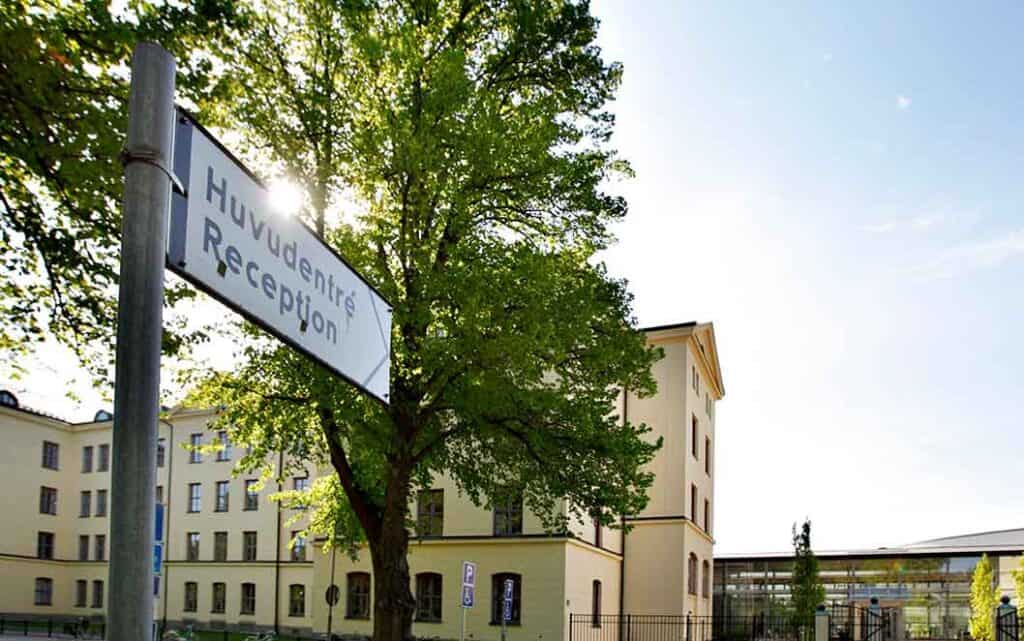
Someone who has been involved in fiery debate with Forssell about the topic is Stockholm University’s Vice-Chancellor Hans Adolfsson. We meet him at his office in Bloms hus, a stately, almost 200-year-old three-storey building on Frescati campus.
He reiterates his view: helping UHR to design citizenship tests is a political assignment that higher education institutions should not be involved in. “The fact that the government has selected two higher education institutions and tasked them with supporting another authority in something that falls outside the scope of our core remit is something entirely new,” he says.
How does this impact the credibility of the university?
“If this is something we want to institutionalise, we could end up with any sort of commission based on a political agreement or suchlike. It goes against the established practice of maintaining an arm’s-length relationship between the state and higher education institutions. In the long term, it could erode trust in academia.”
Initially, the Swedish language test was also supposed to be ready by August this year. Following protests from the university management, the deadline was pushed back by a year, but even that is not long enough, he claims.
“Our timetable remains unchanged. We still believe that we need at least three years to develop the Swedish language test. It has to be carefully designed, and we need to validate that it works.
Why does it take so long?
“The test needs to be conducted in a legally sound manner. It needs to be as neutral and objective as possible.
You have said that the universities’ current status as state authorities makes them vulnerable to direct political control. How would a change in organisational form provide better protection?
“A change in organisational form, whereby higher education institutions are no longer state authorities, would mean that the duty of obedience applicable to state authorities would no longer apply. Such a change would create greater arm’s-length distance between the political sphere and higher education institutions, thereby strengthening institutional autonomy and academic freedom.”

In another part of Stockholm University, Karolina Wirdenäs, Head of the Department of Swedish Language and Multilingualism, is meeting some of her colleagues who are involved in the production of the citizenship test in Swedish language.
“We made it clear from the outset that it would take us at least three years to develop a test. The fact that the government has postponed the deadline for the test to be ready until October 2027 does not change our timeframe. If they want it to happen more quickly, they’ll have to ask someone else to produce the test,” she says.
Vendela Blomström, the head of Swedish as a Foreign Language, nods in agreement. “It’s like asking someone to bake sourdough bread in 30 seconds. It will never be sourdough bread because it needs to go through a proving process,” she says.
When the department receives a commission from authorities such as the Swedish National Agency for Education, it follows a standard procedure, which involves a request for quotation and a tender from the higher education institution, Wirdenäs explains. “We can then assess whether we have the expertise and the prerequisites to take on the assignment. We check whether it is in line with what we do and whether we have the required resources available. In this case, however, Stockholm University was commissioned directly, so the question of whether we should do it never arose. We have therefore not had the opportunity to say either yes or no to the assignment.”
The University’s normal activities must remain unaffected. Teaching, research and the development of other examinations must continue as normal. This means that both a redeployment of expertise and new recruitment are necessary if they are to put the pieces of the puzzle together.
“I’ve always been drawn to working on large-scale language tests and see it very much as a craft, says researcher Lars Bokander, who has been recruited to develop the citizenship test.

Lars Bokander
Researcher at Stockholm University
What are you working on at the moment?
“We’re reading research literature, looking at what other countries have done and brainstorming freely about what could be included in the test. Trying out sample questions is a major part of the work,” he says.
The University of Gothenburg managed to produce the test on Swedish society and institutions in time for this year’s deadline. Why do you need more time?
“The paper on Swedish society is a knowledge-based test,” says Blomström. “What we’re producing is a skills-based test. They assess completely different competences. The government report that forms the basis for the introduction of the citizenship test states that it will take three to five years to develop the Swedish language test.”
One of the things that takes time is getting people to volunteer for test panels and investigating the effects of background factors.
“We need to find out whether a particular test question systematically favours or disadvantages a group of participants in a way that has nothing to do with their language skills. Perhaps people from France do very well on one particular question, while people from Germany do poorly. In that case, there is something problematic about that question, and you can only find that out by recruiting a large number of French and German people,” says Bokander.
The level of the citizenship test questions is based on the Common European Framework of Reference for Languages (CEFR), which serves as a guide for anyone who teaches language and assesses language learning.
“That’s what we have to refer to,” says Bokander, “but the CEFR was developed in a different context, so we have to interpret how we can use it for our purposes.”
How do you view the fact that, by being tasked with developing citizenship tests, higher education institutions risk becoming more closely involved in politics?
“It obviously raises serious concerns,” says Karolina Wirdenäs. “Imposing such an assignment on higher education institutions risks damaging relations between the government, ministries and the institutions themselves. Naturally, we wonder whether this kind of thing will continue and, if so, what effects it will have on academic freedom.”
For the University of Gothenburg, the first phase of the task, developing the Swedish society and institutions test, has been completed.
“There has certainly been time pressure. But unlike Stockholm University, we have not needed to recruit new staff,” says Alli Klapp, Head of the Department of Education and Special Education.

Alli Klapp
Head of the Department of Education and Special Education
The next phase involves analysing the test.
“For example, we need to see how well the questions work and ensure high quality standards when it comes to measurement. We have been tasked with carrying out a preliminary study and developing a test that must first be trialled. In our analysis work, we are following the standard procedure that is always applied to test design. What the test is then used for is a political matter,” says Klapp.
The Swedish society test consists of multiple-choice questions, with one correct answer. Marking is carried out automatically, and the results are expected to be finalised in October, after which they will be sent from UHR to the Swedish Migration Agency.
“If you pass the test, the citizenship application process will continue. If you do not pass, you will be able to retake the test this time. When and in what form that will take place has not yet been decided,” says Andreas Sandberg, head of unit at UHR, who is responsible for administering the test.

Andreas Sandberg
Head of unit at UHR, who is responsible for administering the test
On the day of the test at Stockholmsmässan, UHR had around 70 people on site, including examiners and hosts. The exhibition centre provided a further 20 or so people.
There is no approved plan yet regarding where and in which venues future citizenship tests will be held. Involving more higher education institutions is one option, but during termtime, their premises do not have much excess capacity, and there are other possible solutions, Sandberg explains.
“Logistically, the Stockholmsmässan exhibition centre worked well, and it is quite possible that we will continue to use commercial providers in the future. We wanted to create an environment that was as welcoming as possible for the participants. Many of them were very nervous.”

Security is another aspect that requires careful planning.
“For us, this is a new venture, involving a large number of people. So it was important to be well prepared for unexpected events. What do we do if an alarm goes off? How do we manage security around the test if we need to evacuate the building?”
Isn’t the link to migration policy a security issue?
“It was a factor, of course, but that is difficult for us to assess, as we have not worked with these issues before. No incidents occurred during the test.”
The pilot test was free of charge, but in future UHR will charge a fee of SEK 2,000. People doing the test will have to cover any travel and accommodation costs themselves.
Stockholm University maintains that the Swedish language test will take at least three years to develop. How is UHR dealing with the possibility that there may not be a test in 2027, as required by the assignment?
“The debate about Stockholm University’s stance on the language test is well known and is primarily directed at the Ministry. We haven’t received any changes to our remit. We’re planning to be able to hold a Swedish language test in October 2027. We can’t do anything else,” says Sandberg.
Unlike this year’s pilot version, the Swedish Migration Agency has said that no decision has been made regarding the possibility of retaking the test for those who do not achieve a pass mark in future citizenship tests. The first test on Swedish society was conducted as a trial run, partly to test and evaluate the test questions. It was therefore a special test session, and this is why participants who do not achieve a pass mark will be given the chance to retake it.
Had those who sat the test on 15 August been informed about what would happen if they did not pass that exam?
“Yes, we provided this information in the notification letter sent out in Swedish to test participants on three separate occasions in June,” says Marvin Hansson, a press officer at the Swedish Migration Agency.
Can we assume that everyone was able to understand the information?
“Given that the test is conducted in Swedish, we have to assume that candidates are also able to understand the notification letter in Swedish.”
How long will it take from a pass result being confirmed until a final decision on citizenship is made?
“It’s difficult to give a general timeframe. The results are reported to us at the Migration Agency automatically by UHR. How long it takes to process a case depends on whether further investigation is needed and what the workload is like for our case officers at that particular time,” says Hansson.

Outside the Stockholmsmässan exhibition centre, Catherine Mollel hopes she will receive a quick response. She is a nursing assistant and works in healthcare in her hometown of Jönköping. She is originally from Tanzania and moved to Sweden ten years ago.
“It’s good to know about society, but at the same time it feels as though the government wants to make it difficult to become a Swedish citizen,” she says.
“I came here yesterday and stayed the night with my sister, who lives nearby. I’m going to continue my studies soon to become a nurse, but it would be good to know first that I’ll be granted Swedish citizenship.”
The citizenship test is used to assess whether applicants for Swedish citizenship meet the requirements regarding proficiency in the Swedish language and knowledge of Swedish society. The test is being introduced in stages.
The Swedish Migration Agency decides who is eligible to sit a citizenship test. You can only register if you have received a notification letter from the agency.
It is possible to meet the requirement for basic knowledge of Swedish society in other ways, in which case you do not need to sit the test. In such cases, you must demonstrate your knowledge of Swedish society by providing evidence of a pass grade in social studies or basic social studies subjects from Year 9 or upper secondary school. Studies at folk high schools at upper secondary level and in adult education (Komvux) are also accepted.
The same applies to the Swedish language test. Anyone who has an upper secondary school pass grade in Swedish or can otherwise demonstrate their proficiency in Swedish in accordance with the regulations is not required to sit the language test.
The citizenship test can only be taken in Swedish.
Sources: The Swedish Migration Agency and the Swedish Council for Higher Education (UHR)