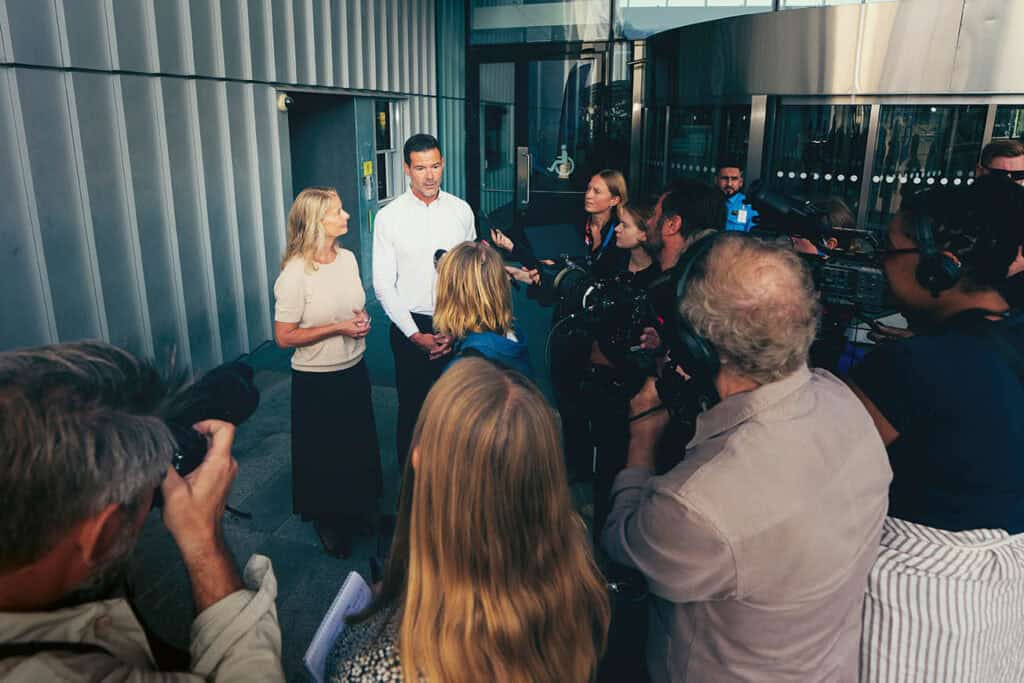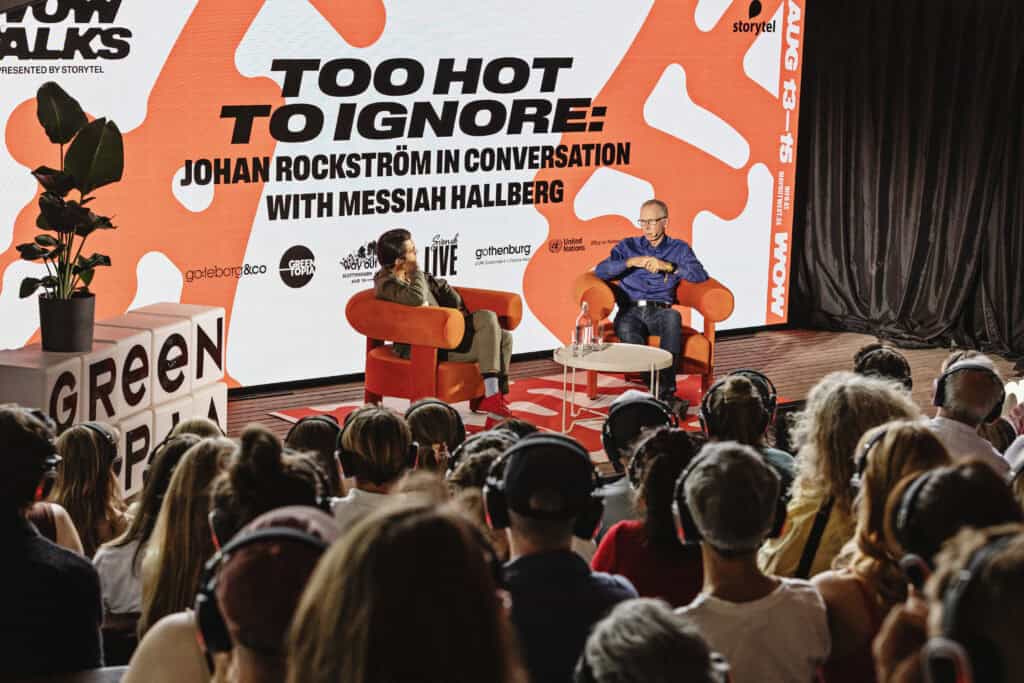
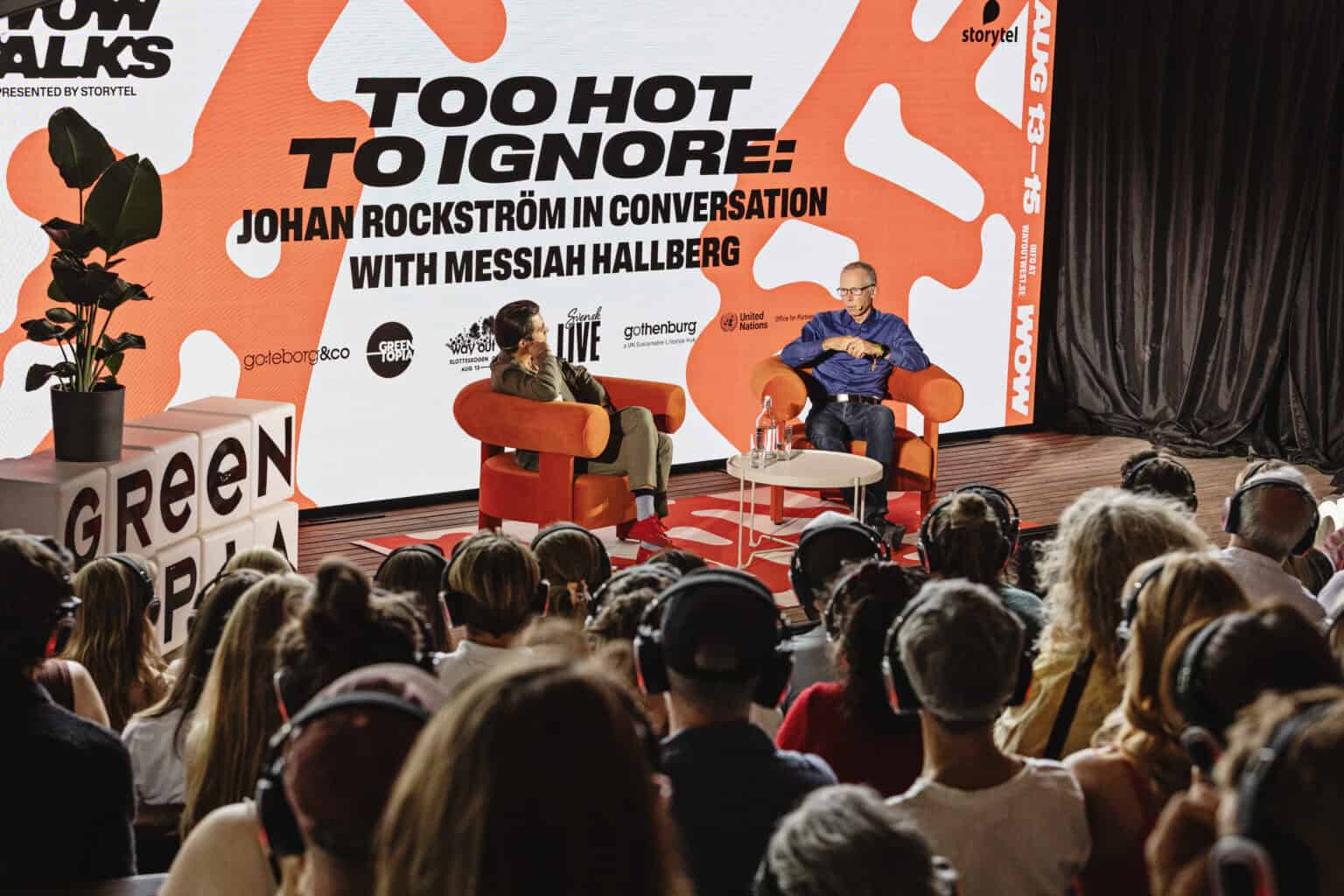
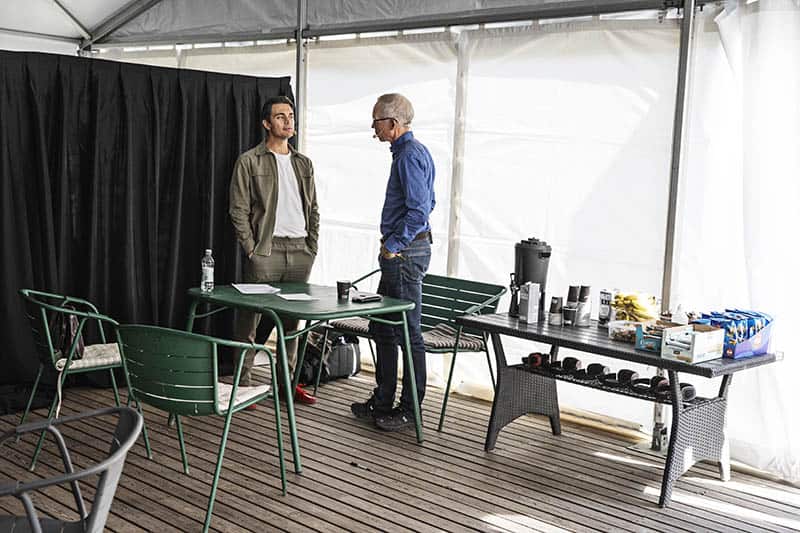
Behind one of the smaller stages at the Way Out West festival in Gothenburg, climate scientist Johan Rockström is sitting on a green metal chair. He looks just as he usually does. His hair is short and fair, he’s wearing his glasses, and he has his blue shirt buttoned all the way up. His shirt is tucked into his jeans. He has just been in conversation with the comedian and TV presenter Messiah Hallberg in a talk entitled ‘Too Hot to Ignore’ and will soon meet his daughter on the festival grounds. The air is thick with the sound of various types of music and a buzz that only a park where around 30,000 people are gathered at the same time can create.
“I think it’s important that we academics both dare to engage in and make time for this sort of talk,” he says. “It’s important to be in contexts like this – music, but also sport, all forms of culture. We don’t do it nearly enough. What shapes our career paths is writing and reviewing academic papers and teaching. And then you apply for funding for research projects. That’s the bread and butter of an academic.”
“Of course we give lectures, but at scientific conferences or to the business community or politicians. So this sort of cultural event ends up at the bottom of the list. That’s one explanation. The other explanation is that many people feel a little uneasy. It’s a different kind of conversation; you’re expected to be a bit quick-witted. As an academic, you’re not really used to giving quick, more rounded answers. You tend to be very thorough and belt-and-braces in your responses, which is often important. In the conversation we’ve just had on stage, I know I took a few risks. Someone out there might have recorded it, posted it online and said that you can’t explain it that simply. It’s the kind of format where you can’t sit there giving standard deviations for everything,” explains Rockström, who is used to putting himself in this sort of situation.
He believes that he and other experienced researchers have a responsibility to explain to new, younger researchers how important it is to practise being in places like this, outside the academic world. Ultimately, this makes them better at their core work, he says, adding that it is not often that academics are invited either. It takes two to tango.
During the festival, you don’t see much of what Slottsskogen normally looks like. Instead, the area is full of temporary stages, technical equipment, barriers, food trucks and tents. The sponsors are also extremely visible. The programme on the discussion stage, Slottsskogsteatern, is presented by Storytel, a Swedish e-book and audiobook subscription service, and the same company has provided the headphones which all audience members are given to listen to the talks, dubbed WOW Talks and Greentopia Talks.
“As an academic, it’s important not to make the mistake of giving the impression you’re taking sides. Being a credible, independent voice is one of the most important assets we have,” says Rockström, referring to the abundance of brands on site and in the festival’s external communications.
He is well aware that there is a danger that discussions with researchers on climate and sustainability will simply become just one thing on the festival line-up among many; that afterwards the audience will sum up the festival by saying, “Nick Cave was great, Jehnny Beth too. Oh, and Johan Rockström as well!” But he believes we must see it as a positive sign that these issues are becoming mainstream. That this in itself is a step in the right direction. Otherwise, they will remain confined to some environment ministry or environmental protection agency. They need to become mainstream.
Over the years, Rockström has come to, as he puts it, take this sort of work more and more seriously, and he tries to make himself available when time allows. It’s also about getting the message – or messages – across. He talks about working on a documentary featuring celebrities, and how, for example, Artists like Peter Gabriel and Billie Eilish play a key role in helping to proclaim that ‘enough is enough’. For instance, he spoke at an event where Billie Eilish gave a major concert in Berlin. It becomes a tool, a way of influencing more people and having a greater impact.
Plate is a research centre for resilient, environmentally sustainable and healthy meals, and is coordinated by the Stockholm Resilience Centre at Stockholm University. During the festival, Plate has arranged is a workshop, Plate Out West, in collaboration with Göteborg & Co, the City of Gothenburg’s own events company, and the festival organisers. The attendees are people who are part of the food industry in one way or another. How can everyone involved help shape the meals of the future, where sustainability, health and preparedness go hand in hand? The atmosphere in the conference room in the Gårda district of central Gothenburg is completely different from the hustle and bustle of the festival, but it all ties together.
Line Gordon heads the Stockholm Resilience Centre and took over from Johan Rockström when he left to become director of the Potsdam Institute for Climate Impact Research. She tells us that ever since the centre was set up, with funding from the independent research funder Mistra, collaboration with the wider community has been a key part of its mission.
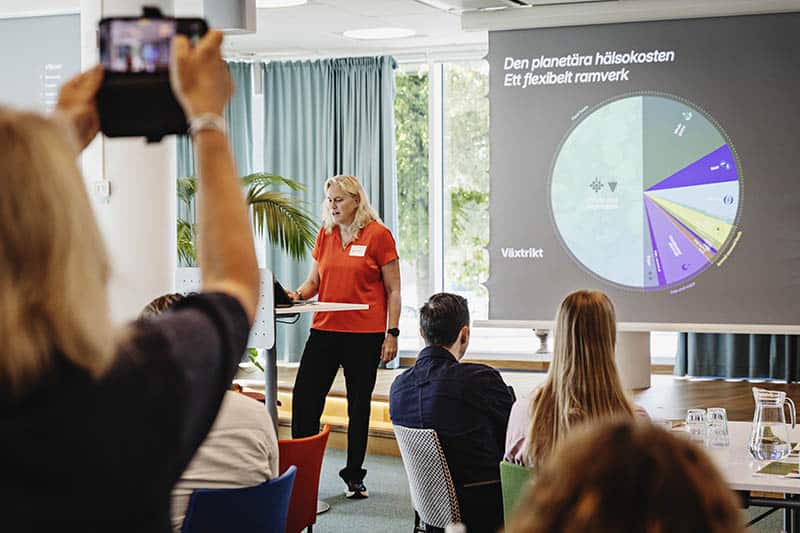
“We’ve always wanted to find ways to reach out and disseminate our research,” she continues. “We need to communicate in many different ways. And we need to talk to people in different ways. Culture plays an important role here in bridging the gap between our dry analyses and how they might be perceived by the wider community. But even within our research, it can be a vital part of understanding and interpreting the world around us in different ways.” She adds that while their focus is on research, outreach and external engagement are important, both for the centre and for Plate, which in a manner of speaking is a centre within the centre.
This is where the band Bob Hund comes into the picture. Plate has long collaborated with Live Green, which works to make festivals greener, and after much back and forth, singer Thomas Öberg and the rest of the band took the opportunity to do something “to make the music industry 1.5 degrees cooler”. When they were preparing for their farewell tour last year, the door opened for the first Plate Lab – I stället för Bob hund: Matvagn (‘Instead of Bob Hund: Food Truck’). The aim of the lab – the experiment – was to test how two dishes designed according to the Plate principles, with focus on the environment, health and sustainability, and served from the food truck would be received in a commercial and fast-paced food environment. The food truck was used three times during the summer of 2025: at the Way Out West festival, at Medborgarplatsen in Stockholm, and at Bob Hund’s very last gig at Zinkensdamm stadium, (or at least “the last one with crowd barriers”). In its lab report, in its assessment of environmental and nutritional principles, Plate concluded that the two dishes “perform significantly better than typical festival food on almost all parameters.” This includes a lower carbon footprint, a higher proportion of organic ingredients and a nutritional content more in line with recommendations. However, the salt content was too high in all the dishes, including ‘1 Falafel-ish and 1 solution’ and ‘Let me finish my punk stew!!!’, dishes whose names were inspired by a couple of Bob Hund’s most famous songs.
Per Olsson, a researcher at Plate and deputy head of research at the Stockholm Resilience Centre, was born and raised in the small town of Arvika, close to the Norwegian border, and has always been interested in music. About twelve years ago, he realised that he missed the world of music and decided to see what would happen if he tried to bring the two worlds together. Collaborations with Way Out West, the author Andri Snaer Magnusson, folk music artist Sara Parkman, Bob Hund and the Kronos Quartet are just some of the results. The collaborations involve everything from shining a spotlight on nuclear disarmament to loss of species to how language also needs to change when society needs to change. This is his way of engaging with society.
“Whenever the Stockholm Resilience Centre has organised meetings or held conferences, culture and the arts have always been part of the event. But this is now becoming even more substantial. We reach out to society, civil society, the public sector and the private sector. This is part of that work,” he says.

Admittedly, securing funding for this type of transdisciplinary collaboration is a challenge, but he believes that things have improved significantly over the years, compared with when he started 30 years ago. He emphasises that, regardless of the nature of the collaboration, it is always essential to establish principles together. What rules or principles will guide the collaboration? How shall we talk to and listen to one another? How do we deal with conflicts?
“Then you can always refer to these rules and principles to address whatever comes up as the work progresses. And you have your own moral compass and integrity, of course. You have the right to say that this context or this collaboration isn’t working for me,” he explains.
Naturally, there must be some sort of love and respect for – in this case – artists such as Bob Hund and Sara Parkman. But, he stresses, a little friction is no bad thing. It must be possible to come from different perspectives when collaborating on a change.
“We believe in that friction. If you’re working on change and there’s no friction, then you’re probably working on adaptation rather than change.”