What effect do the built environment and local surroundings have on whether we choose to walk or not? And how do attitudes, gender and age influence this?
“Walking is the only mode of transport that is universally accessible, regardless of age, income and social status. It also has many benefits for health, the environment and the economy. At the same time, walking has declined, both in Sweden and the rest of the world,” says Anindita Mandal.
Using a GPS-based mobile app, she has mapped the walking behaviour of 640 residents in two Swedish cities. Their movement patterns have then been combined with data on their physical surroundings – including building density and tree density – and survey data on their attitudes towards walking and their built environment.
In her thesis, she shows that attitudes have the greatest effect on walking behaviour, but that the local environment also plays a major role.
“For example, tree density is important. More trees in the city not only influence people to choose that particular walking route, but also encourage more walking in general.”
Other contributing factors include a well-developed network of footpaths. And the presence of ‘points of interest’ to stop at, such as museums, cafés and restaurants. Pedestrians also shouldn’t have to cross busy roads.
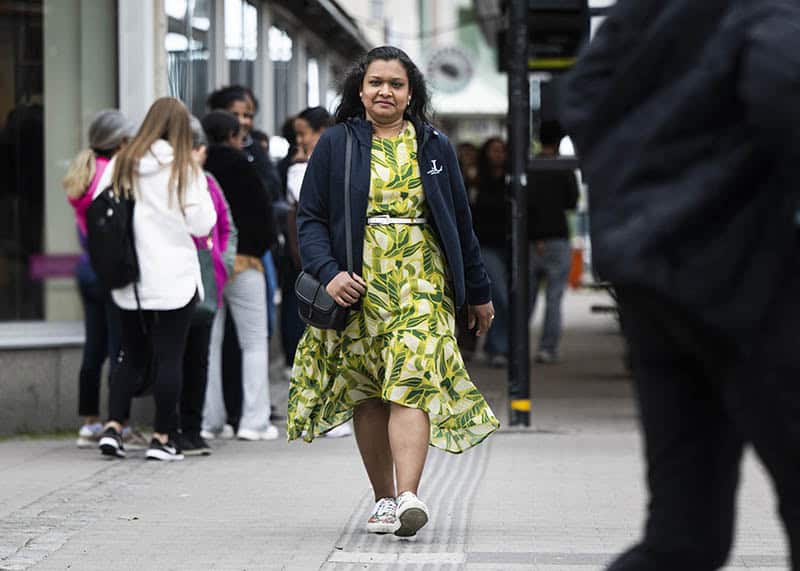
Aninidita Mandal herself walks to her job every day.
“I love walking. I find it very relaxing. For me, it’s a combination of transport and recreation.”