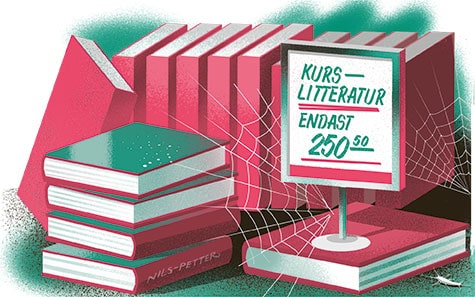
Following a steady rise in sales of course literature between 2001 and 2011, sales levelled off before reaching a new peak during the pandemic year of 2021. Then sales plummeted by 40 per cent in the period until 2024. The figures for the publication of course literature have now stabilised, but at a much lower level than before.
Håkan Pihl, Vice-Chancellor at Kristianstad University, is one of many who are concerned about the future of course literature.
“The situation for course literature is problematic,” he says. “Publication has fallen drastically, and if this trend continues, there will hardly be any course literature published in Swedish at all, and that would be a serious issue.”
Håkan Pihl
Vice-Chancellor at Kristianstad University
Why is it problematic?
“Students whose mother tongue is Swedish probably learn better if they have course literature in Swedish, especially in the early stages of their studies. There is also often a need for course literature that addresses conditions in Sweden.”
Generally speaking, a variety of course literature and course literature tailored to different requirements is needed. It is important that there is high-quality course literature is available. Now that publication numbers are falling, there is a danger that this will have negative effects on the quality of education in the long term, Pihl explains.
The government is also concerned. “The crisis in reading is becoming increasingly apparent,” writes Lotta Edholm, Minister for Higher Education and Research, in an email to Universitetsläraren.
“This is a worrying development, as it risks jeopardising students’ knowledge acquisition and their ability to use course literature.”
Lotta Edholm
Minister for Higher Education and Research
She points out that the government has tasked the Swedish Higher Education Authority (UKÄ) with reviewing the situation.
“We must reverse the trend and take early action,” she adds, “starting at pre-school and primary school levels. The Liberals in the government are therefore carrying out a complete overhaul of the Swedish school system.”
UKÄ has surveyed the use of course literature on the government’s behalf. In a new report, the agency has compiled answers to questions it put to departments, libraries and student unions at higher education institutions. The report shows that a large proportion of the teachers surveyed believe that students are reading course literature to a lesser extent than before.
“Many teachers find it problematic that students do not read the course literature or engage with it,” says Anna Lundh, an analyst at UKÄ. “But it is also true, as some say, that students seek out other material that enables them to learn what they need to.”

Anna Lundh
Analyst at UKÄ
She believes that there is a greater variety of teaching resources today than there was 10–15 years ago. UKÄ’s survey also shows that there is greater variation in what teachers say students should seek out.
“As we found, the reading list might include students watching YouTube clips to learn how to perform a practical manoeuvre of some kind. Also in IT courses, there is plenty online for students that they are instructed to look at.”
However, the mathematics departments interviewed by UKÄ, for example, believe that when students search online for alternatives to course books, this can lead to misunderstandings.
“Students can also use AI tools as study partners and discuss things with them. You could say that, in order to pass their courses, students use all the resources available to them,” says Lundh.
Those most directly affected, the students, also see the problem and believe it is largely financial.
“We think about it very much from a financial perspective,” says Colin Andersson, chair of the Saco Student Council. “Students need to be able to afford to buy course literature. And in recent years, with high inflation and rising rents and food costs, it has been difficult for many of them to feel they can afford to spend money on course literature.”

Colin Andersson
Chair of the Saco Student Council
He believes that the availability of so much material online plays a major role. “But it is a mixed bag, because there are some negative aspects to AI. And piracy is illegal, and so problematic in that sense. At the same time, digital material is much, much more accessible, for example digital course literature that you can access via university libraries. Generally speaking, digital material is good for many people, as it is easier to get hold of. But of course it has to be legal.”
The Swedish National Union of Students (SFS) is sceptical of a commonly cited explanation for the crisis in course literature: that students are reading less.
“It is worth bearing in mind that even though sales of books have fallen, that does not mean that students are reading less,” says Rasmus Lindstedt, Chair of SFS. “The Swedish Higher Education Authority (UKÄ) has just examined the issue of course literature usage. And it is clear that while teachers say they feel students are reading less, I note that the students themselves have not been asked.”

Rasmus Lindstedt
Chair of SFS
He gives a more nuanced picture of students’ study habits:
“You could also add that Swedish students today have the second-lowest number of teacher-led hours in the whole of Europe. But at the same time, Swedish students are at the very top in Europe when it comes to self-study hours. So Swedish students devote a great deal of time to their studies.”
Måns Svensson, Vice-Chancellor at Jönköping University and Chair of the Association of Swedish Higher Education Institutions’ expert group on university libraries, widens the discussion on the crisis in course literature.
“When talking about this crisis,” he explains, “you have to be a bit careful about how you define the term ‘course literature’. Course literature is a broad concept. Over time, it has encompassed a combination of books written in Swedish, books written in English, as well as articles in the databases our libraries subscribe to.”

Måns Svensson
Vice-Chancellor at Jönköping University and Chair of the Association of Swedish Higher Education Institutions’ expert group on university libraries
He describes a crucial difference compared with the past:
“I would say that the fundamental change taking place right now is a technological shift. As we see it, it is a specific business model within this system that is in crisis. The biggest challenge right now is the publication of Swedish course literature in book form, in paper form. There, we can clearly see that it is difficult to make money within the old business model. History is full of examples where new technology changes the conditions and old business models struggle to survive.”
As for the much-discussed reading crisis, Svensson agrees with the Chair of SFS.
“It is a mistake to conclude that our students are not reading simply because publishers are not selling. They are reading in other formats instead. For example, academic articles or compendia written by and uploaded directly to course platforms by the lecturers running the course are also course literature. It is a different way of distributing it.”
Svensson points out that the clear major trend is towards digital products, where it has previously been a challenge to find business models for e-books that work for all parties – universities and university libraries on the one hand and publishers on the other.
“It has been very difficult to make it work. But now we have been hit by a second wave of technological change, as AI is turning things upside down again. Because today, young people are used to being able to take the texts they are supposed to read, feed them into their AI and then discuss the text with their AI. And that is very hard to do with books.”
Also among those most directly affected are the publishers of textbooks. Stefan Persson, CEO of the educational publisher Studentlitteratur and chair of the trade association Läromedelsföretagen, explains the background to the current situation.
“I think you have to go back a few years to put it in the right context. During the pandemic, Swedish universities were closed; students could no longer go there and take part in lessons. That was when the importance of course literature for students grew.”

Stefan Persson
CEO of the educational publisher Studentlitteratur and chair of the trade association Läromedelsföretagen
After the pandemic, sales of new Swedish course literature began to fall rapidly.
“Sales fell by about 40 per cent over a couple of years. Obviously, this was a significant financial blow to us as publishers. You have to bear in mind that course literature is really a market where you sell very few copies. I would estimate that an average Swedish course book sells around 300 copies a year. So print runs are very small, and that naturally makes the market sensitive to changes.”
Several factors contributed to the decline in sales.
“There was a huge glut of second-hand books following the pandemic. And we had the government service Legimus, (a service for accessible literature), which distributed course literature to large groups who can hardly be considered to have impaired reading ability according to the definition in the Copyright Act.”
Added to this is the technological shift as more and more study materials go digital.
“The member companies of our trade association account for almost all Swedish course literature, and the sales of digital services for the course literature market coming from publishers are very small. They amount to a few per cent of total sales. On the other hand, there is a significant amount of illegal file-sharing, both in closed Facebook groups and in various other contexts,” says Persson.
Since autumn 2024, the situation regarding the publication of course literature has stabilised.
“We are no longer seeing a drastic decline. But we are not seeing an upturn either. So obviously our member companies are now cautious about making aggressive investments in course literature.”
It is also well known that students use free online resources, for example to find solutions to mathematics problems.
“We could debate whether it is reasonable for a student studying at a Swedish university to have to rely on free material online, the quality of which cannot be guaranteed. Is this how we envisaged higher education in Sweden should work?”
Persson also points out that students in Sweden have the second-lowest number of teaching hours in Europe.
“When we talk about the quality of higher education, I think we have a truly toxic combination: very few teaching hours, very little support for students who are left to their own devices with their studies and, on top of that, have no access to course literature.”
Per Kornhall is the Chair of Läromedelsförfattarna, the Swedish trade association for authors of educational literature, and has spent the past year debating in the media about course literature for higher education.
“The situation is very, very difficult for the publication of Swedish-language course literature, as we demonstrated in our report ‘The Perfect Storm’ just over a year ago.”
“Sales have fallen,” he explains, “and so the financial basis for covering the costs of printing and layout, paying authors, paying editors and so on has shrunk dramatically. Quite simply, only half as much course literature can be published.”

Per Kornhall
Chair of Läromedelsförfattarna, the Swedish trade association for authors of educational literature
But he points out that the problems are not because students, or teachers, do not want the course literature or do not acquire it.
“There are many different ways to get hold of course literature without having to pay for it, which threatens the Swedish publication of course literature. But people are not paying for digital material either. In that sense, the crisis is technology-neutral.”
The authors’ trade association report highlights a range of factors behind the crisis in course literature.
“There is the second-hand market, which has become more efficient. There is illegal digital downloading. But there is also the anglicisation of Swedish higher education. And students’ reading habits. Perhaps it is also the case that some students are letting AI summarise the course literature instead of reading it themselves,” Kornhall explains. “This raises some pedagogical questions: How does AI impact the students’ own knowledge acquisition? How does anglicisation affect learning?”