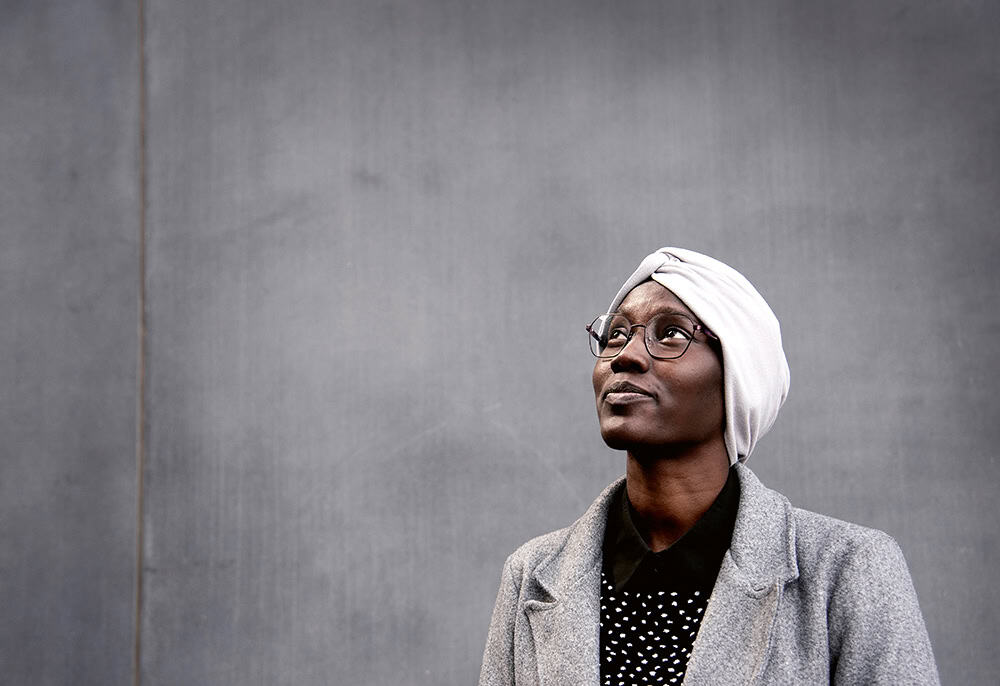
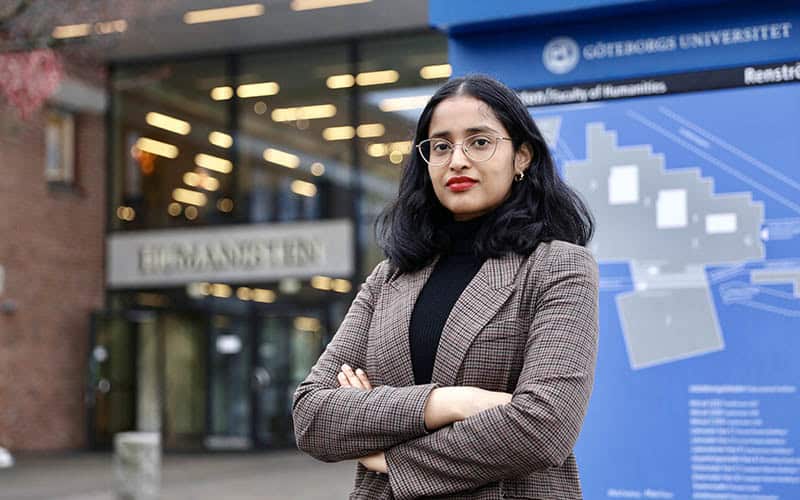
Fahima Ayub Khan began her doctoral studies in linguistics at the University of Gothenburg in 2021. In the summer of 2024, she was granted leave of absence from her departmental duties for 20 per cent of her hours so that she could focus entirely on her research. When she later applied for an extension to her residence permit, her application was rejected. The Migration Agency deemed that she no longer met the requirement for full-time studies because she had been on part-time leave of absence.
“I couldn’t believe it,” she says. “I had no idea that was even something that could happen in my case. I came to Sweden to do a PhD, and that’s what I’ve been doing.”
She appealed against the decision with the support of the public interest law firm Centrum för rättvisa. In June, the Migration Court ruled in her favour and granted her the residence permit she had applied for. The court found that her actual pace of study had not changed during her leave of absence.
For Fahima Ayub Khan, the ruling brought a sense of relief. “I felt vindicated. I always believed that I had done nothing wrong, and the court has now confirmed that.”
It was a long process. For almost two years, she was without a valid residence permit, first while the Migration Agency was processing her case and then during the appeal process. This limited her scope to travel outside Sweden, and the uncertainty affected both her mental wellbeing and her ability to conduct her research.
“Mobility is extremely important for a researcher,” she says. “You need to be able to present your research in different academic settings, undertake research visits and participate in conferences and workshops. These are the things that also advance your career.”
The situation also made it more difficult for her to concentrate on her thesis. “I thought that I would have completed my PhD by now and be able to take the next step in my career. Instead, a lot of my focus has been on worrying about what will happen next.”
Fahima Ayub Khan thinks that cases like hers could impact Sweden’s ability to attract international doctoral students and researchers. She believes that anyone choosing to conduct research in another country considers not only the academic environment, but also the conditions for living and working there.
“This does not paint a positive picture of Sweden and Swedish academia internationally. Research is built on the ability to exchange knowledge across borders. When people come here to conduct research, they uproot their entire lives, and so how they are treated in the country also matters.”
She says that she has seen other international doctoral students leave Sweden or consider doing so. “And I am also unsure about what I will do next. There is a great deal of pressure on top of the pressure already involved in doing a PhD.”
Alexander Troedsson, the lawyer at Centrum för rättvisa who represented Fahima Ayub Khan, believes that the Swedish Migration Agency’s approach in this type of case is far too formalistic and can result in legal uncertainty for international researchers. The firm has taken up several migration cases involving researchers and doctoral students. In his view, this ruling also raises the question of how doctoral students should be regarded under immigration law.
“In these cases, the Migration Agency treats doctoral students the same way as it treats other students. This ruling confirms that doctoral students are to be regarded as researchers as far as possible, not like students at undergraduate or master’s level. The ruling also emphasises that there must be a degree of reasonableness when authorities take decisions that have a significant impact.”

Alexander Troedsson
Lawyer at Centrum för rättvisa Foto: Linda Broström
Troedsson refers to the European Union’s Student and Researcher Directive, which urges member states to treat doctoral students as researchers where appropriate. He argues that the distinction has practical significance, not least because doctoral students’ work may require greater international mobility than studies at undergraduate and master’s levels.
The Migration Agency has appealed the decision. In the appeal The Migration Agency states that a PhD must do full-time studies, 100 per cent, to meet the requirement. Fahima Ayub Khan was, according to The Migration Agency, reaching an activity level of just 80 per cent of her hours.
The Migration Court of Appeal has not yet announced if the case will be accepted for trial.
New rules for international doctoral students
In June 2026, new immigration rules for international doctoral students and researcher came into force. These mean, for example that
- doctoral students with a hosting agreement can apply for a residence permit for research,
- more people can apply for residence permits for research or doctoral studies without having to leave Sweden to do so,
- residence permits to seek employment after completing their studies or research now have a longer period of validity.
At the same time, the rules for international students have been being tightened, including stricter requirements regarding academic performance and restrictions on part-time work alongside studies.
Source: The Swedish Migration Agency