The regulations on export controls for dual use products and military equipment are around 400 pages long. If you add sanctions, that takes it up to 1,000 pages.
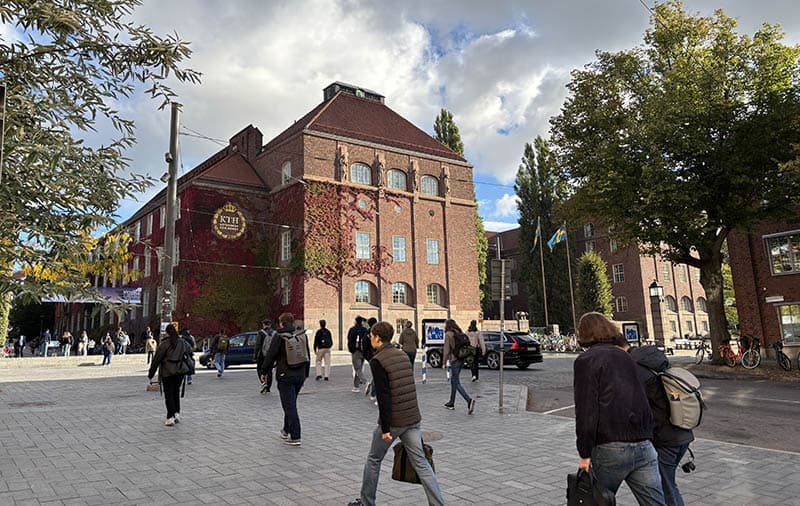
“Understanding and interpreting this legislation and applying it to research projects, collaborations or recruitment is a specialist skill in itself,” says Thom Thavenius, Deputy Head of Security and Safety at the Royal Institute of Technology (KTH).
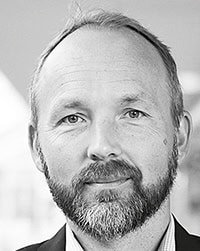
Thom Thavenius
Deputy Head of Security and Safety at the Royal Institute of Technology (KTH).
One of the people at KTH who supports researchers with export controls competence is Fredrik Karlsson. He sees a major problem in the fact that the definition of what is meant by dual use has been so unclear and shifting in the discussions regarding Horizon Europe.
According to EU export controls regulations, dual use products (DUPs) are those that have a civilian use but could be used for military purposes or to create weapons of mass destruction. These can include technology, materials, software, chemicals, consulting services, design drawings and more.
If research is conducted with the aim of developing a DUP, export controls may come into play. In such cases, a licence may be required to share the product and information outside the EU, including through publication of an article, a research collaboration or with a visiting researcher at your own department.
“Circuit boards for rockets, for example, are DUPs, and precise information on how to develop them is subject to export controls. So before publishing, as in exporting the information to the whole world, you need to have a licence. To my knowledge, such a licence has never been granted, and people don’t even apply for one. Instead, you need to make your research results vaguer to publish them.”
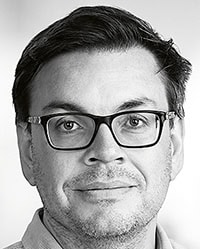
Fredrik Karlsson
KTH
If the research has explicit military purposes, it is classified as military equipment, and thus subject to further restrictions.
“You have to look at things on a case-by-case basis. But if the project plan states that there are military purposes, or if the funding or partners are likely to have military purposes, it is likely to be classified as military equipment.”
When in EU documents and the debate, the term dual use refers to both civilian and military purposes, it therefore pertains to both DUPs and military equipment within the context of export control legislation, Karlsson points out.
“It feels better to say, ’We need dual use’ than ’We need military stuff to threaten and kill people with’. We want to sound nicer when we talk about terrible things. That is my reflection,” he continues.
Thom Thavenius describes export controls as one of three baskets of security issues that researchers and universities need to take into account. The second basket contains the Protective Security Act, which focuses on matters that are important for Sweden’s national security. This is referred to as security-sensitive activity.
“To put it bluntly, if the research you are conducting is deemed important to Sweden’s national security, you are not permitted to conduct open international research in accordance with all the principles of academia.”
The third basket contains issues relating to research security in a broader sense. It includes direct and indirect requirements linked to safeguarding Sweden’s and the EU’s industrial competitiveness. Here, more research areas and more civil applications may also encounter obstacles.
“The United States can put a stop to collaboration with a Chinese researcher. Companies may have their own security criteria that are not regulated by law. The Migration Agency can block a recruitment process at the last minute after a referral to the Swedish Security Service (SÄPO),” says Thavenius.
KTH manages the balance between openness and security by having open environments as far as possible, closed environments for sensitive research and, when necessary, conducting research at places such as the Swedish Defence Research Agency (FOI), which has a higher level of security.
Even though the line between military and civilian is blurred in terms of funding and application, universities and researchers will still need to draw boundaries of their own.
Pär Olsson has extensive experience of navigating security issues. He is a professor at KTH and conducts research on nuclear energy technology. His focus is entirely within the civil domain, but because nuclear technology could also be used for military purposes, export controls may apply.
In 2024, he needed to send samples containing approximately five grams of natural uranium to the United States for tests that cannot be performed in Sweden. It took him almost six months to obtain the necessary permits.
In order to even be able to assess whether something has a military use, which Olsson believes the uranium samples definitely did not, in-depth knowledge may be required.
“Assessments can be very person-dependent. One person understands the subject and understands your arguments when you say that this has no military use because of X, Y and Z, while another person may not believe you.”
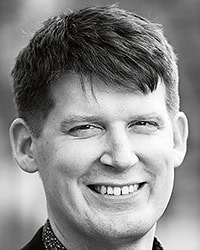
Pär Olsson
Professor at KTH
Due to export controls and sanctions currently in place, he is now unable to employ people from countries such as Iran and Russia. People from other countries, such as China, may end up in the more ambiguous research security basket. That can put people who are recruiting researchers in a difficult dilemma.
“A colleague of mine had ranked a very, very well-qualified postdoc who was working in the United States, but who comes from China, at the top of their list. After six months, the person’s visa application was rejected. Then it was back to square one. Next time, it will probably be another candidate with a Chinese background who is ranked highest, because there are very few people in that field.”
To prevent research from coming to a standstill, organisations may feel compelled to screen out applicants from specific countries when recruiting researchers, regardless of their qualifications.
“It is not great for a state sector employee to feel that the only way I can do my job is by breaking the law. It is very unsatisfactory that there is no clarity about how we should act here.”
At Linköping University, Elin Palm at the Centre for Applied Ethics recently organised a workshop on dual use and good research practice, which attracted around 60 people. In recent years, she has noticed that the doctoral students she teaches research ethics to have begun to react differently to The Uppsala Code of Ethics for Scientists. Since 1984, the Code has been informing discussions about the individual responsibility of researchers, not least in light of the arms race and the risk of nuclear war.
“The Code requires that researchers work to advance freedom and peace. Many people now find that difficult to apply in today’s situation. They see threats and risks that they believe research must take into account. They are also uncertain about their own responsibility for technology and technological development in such unpredictable and unstable times,” she explains.

Elin Palm
The Centre for Applied Ethics at Linköping University
She takes as her starting point the way that the concept of dual use is used more broadly in technology and science studies.
“There, the challenge is to ensure that knowledge and development that can be of great societal benefit is not used for unintended and undesirable purposes, for harmful purposes. We cannot see into the future, but we should identify these undesirable effects before it is too late and before new technology has been launched.”
Contributing to technology that strengthens Sweden’s military defence and democracy may feel entirely appropriate now. But what if it is then used by Russia against Ukraine? By Israel against Palestine? By the United States against Denmark and Greenland? Or by an autocratic Swedish government against its own population?
There is often a support function for export controls at higher education institutions, but the ethical reflections on the convergence between civil and military research need other forums.
“It can be extremely difficult to stand up for your conscience as an individual doctoral student or researcher. And it is difficult to keep yourself updated and have sufficient insight into large collaborative projects,” says Elin Palm.
What is the government’s view?
In an email to Universitetsläraren, Lotta Edholm (L), Minister for Upper Secondary Education, Higher Education and Research, writes:
“Horizon Europe will continue to be based on excellence, be open to dual use technologies and, at the same time, have clear and proportionate rules that safeguard national security, open science and academic freedom.”
”The proposal regarding a separate defence section within the Competitiveness Fund and coordination with Horizon Europe is positive, but the link between them needs to be analysed in greater detail, especially for defence-oriented projects.”
In Sweden, the government wants to ”strengthen cooperation between civil and military research by developing and facilitating civil-military collaboration and exploring how synergies can be better exploited.”