Obviously you can recognise hands. In the same way that you recognise faces. You can see a person’s profes-sion, age, gender or pain through their hands. Swollen or wrinkled, calluses or dirty fingernails. There are all kinds of ways to look at hands, says Tobias Laurell.
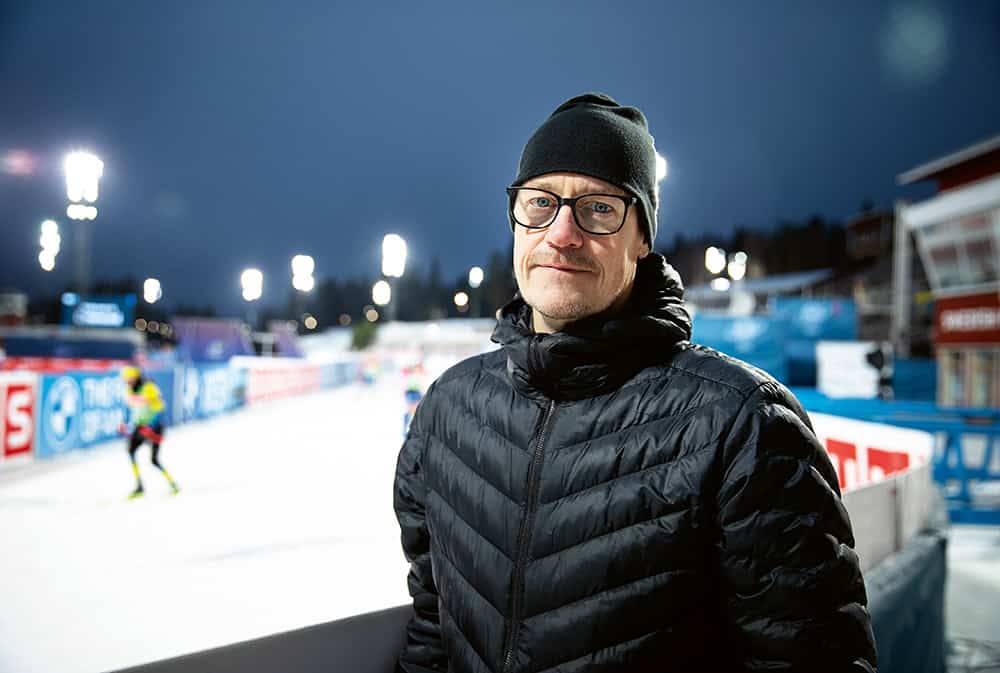
He is the head of the hand surgery clinic at Södersjukhuset Hospital, which is part of the Karolinska Institute in Stockholm. At the end of summer 2025, a double hand transplant was performed there, the second ever in Sweden. Laurell was responsible for planning the process, in which the patient was on the waiting list for two and a half years before the operation could be performed. We will come back to that operation later.
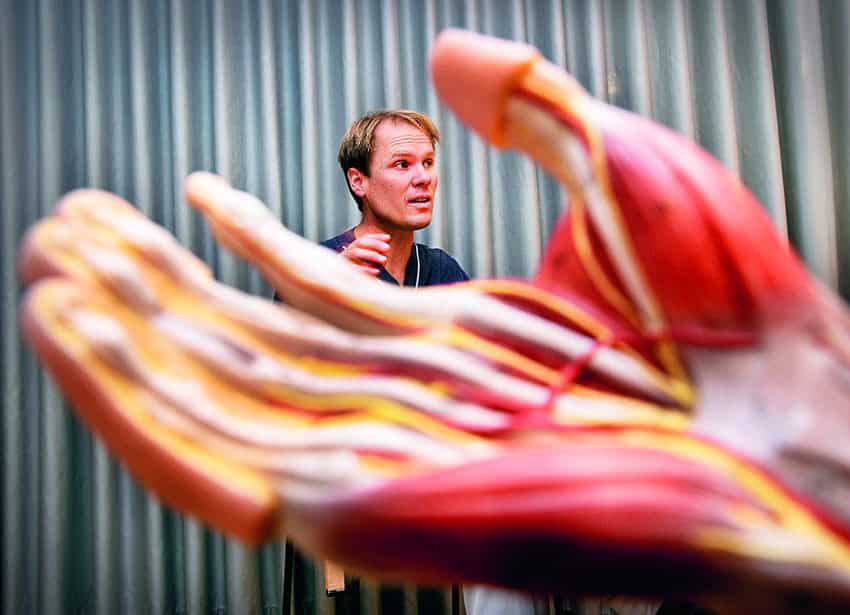
Today, the surgeon, who wishes he had more time for research, is sitting in an impersonal conference room at the hospital. In front of him lies an arm, a teaching model of an arm, to illustrate what it is all about. He studied economics at upper-secondary school and did his military service in the navy, but he is not particularly keen to talk about himself. But when Tobias Laurell talks about hands in his tidy Gothenburg accent, he creates a kind of professional and the researcher poetry. By looking at someone’s hands, he can, at least to a certain extent, con-firm or ”discard” his prejudices.
“Of course I have been influenced by my job, and I should reasonably be able to understand suffering better. I did my residency in hand surgery and have broadened my experience of what hands do. I understand the limita-tions that come with injury or illness.”
He explains that the hand is a complex and detailed part of the body that has many structures and is extremely mechanical, while also crucial for well-being and a person’s ability to function. He also emphasises that the appearance and use of hands in social contexts is important. He describes this as three main tracks.
“Function, appearance, and then I would like to add a third that is about communication and body language and inclusion and, unfortunately, in some cases, exclusion. If you exaggerate. Sometimes people find it awkward when they see something different or when something is missing from a hand.”
“Many people who were born without a hand have been used to it from the start,” he continues, “so there is greater acceptance there. But if you or I were to lose our hands, that would be a disaster.”

In an interview in 2006 in Dagens Medicin, a weekly newspaper covering the Swedish healthcare sector, he talked about his dream of becoming a hand surgeon and how happy he was when he got a job as a resident at Södersjukhuset. He developed an interest in surgery in general during his studies at the Karolinska Institute and says in the article that surgery is something immediate, that you can see the results of what you do right away.
When I remind him of the article, 19 years later, he shakes his head and sighs something about digital footprints and that “that one is pretty embarrassing”.
“As a hand surgeon,” he says, “you have a very clear task with clear structures. But hand transplants are ex-treme cases. 85 per cent of what we do is outpatient surgery; we don’t have much of a ward or do many rounds. We operate and then the patients go home.”
Laurell was and still is attracted to reconstruction, to restoring something that, at a detailed level, has either been damaged or was different from the start. It feels meaningful, he says, adding that there are deeper, personal aspects to his role as a doctor that he does not go into.
He sets clear boundaries during the interview. He is here to talk about hand surgery, here to champion a somewhat neglected part of medical care. He is not here to talk about his dreams as a young man. However, he is happy to talk about teamwork and what it means to work together in an operating theatre, as well as the importance of following up with patients afterwards. Can they suddenly bend something they could not bend before? Have they regained feeling?

He tells us that he has operated on many children, and a look of satisfaction spreads across his face when he explains that it can mean a lot if things work better and look better after the operation. It can give children a bet-ter situation at school. The most enjoyable and rewarding part, he says, is meeting the patients again and finding that things are getting better and better.
As head of the clinic, a large part of his work involves administration and leadership. Many of the hand surgeons there perform many more operations than he does. And he thinks it is important to counter all the bad publicity that the healthcare sector receives in, as he puts it, the general media. He believes that the positive image is sometimes drowned out by the other side, by scandals, by the negatives.
He has some research going on. For example, he is supervising a doctoral student, Nina Rydman, who is work-ing on epidemiology with a focus on childhood hand injuries and looking at socio-economic factors in Sweden. The hand surgery clinic has a very active research group with a handful of doctoral students and about one completed doctorate per year. The research group is led by Maria Wilcke at the Karolinska Institute.
He wrote his own doctoral thesis on clinical genetics, genetic causes of hand deformities. He says that research is a fantastic environment to be in, that he loves using his brain.
“But there aren’t enough hours in the day for me. It is a relatively common role, to be medically responsible and continue to do a little clinical work, but try to weave it all together into a whole.”
Back to the double hand transplant. He notes that the project has been going on for around 15 years and that the patient in question was on the waiting list for two and a half years. In his meticulous manner, Tobias Laurell ex-plains that when they placed the patient on the waiting list to receive hands, the hospital was ready to start the process as soon as the right hands became available. They then ticked off each item on their checklist and moved on to the next step. There are between 100 and 150 hand transplant patients worldwide, depending on how you count them, and many of them have been given two new hands.
“For a very small group of patients,” he explains, “it is a well established and very costly method in terms of commitment, resources and time. But it is being done. In Gothenburg in 2020, in Helsinki last year and now at Södersjukhuset. There are several centres in Europe that do it. It will not become a mass procedure, but I believe it will remain an option.”
One of the reasons it will not become particularly common is that the road is so long for the patient, and it involves a “very specific medical need”.
If disaster strikes, if you lose your hands due to blood poisoning, for example, then you need to heal and adapt to your new life. It is a huge trauma for the individual. Laurell has spent a lot of time on these issues and says that patients in the midst of all this turmoil are expected to start thinking about prostheses, and that some find prostheses work well and use them for the rest of their lives. For others, they do not work at all.
“The disadvantage of prostheses is that they have no feeling, and they will always look like a prosthesis. Mechanically, they are fine. So some patients adapt to a life without hands,” he explains.
“The disadvantage of prostheses is that they have no feeling, and they will always look like a prosthesis. Mechanically, they are fine. So some patients adapt to a life without hands.”
Undergoing a hand transplant also requires a very high level of motivation and strong willpower. People need to train for several hours every day after the operation, and if they cannot commit to that, then they cannot have the operation. This assessment and selection is done together with psychiatrists, psychologists and counsel-lors. It is essential that the patient understands what things will be like and has reasonable expectations. In short: Is the patient ready?
The strict requirements mean that the few who lose both hands face a further level of screening. Obviously people are impacted psychologically by a disaster, by an accident in which they lose their hands.
The operation at Södersjukhuset took 19 hours, and Tobias Laurell describes his role as coordinator and project manager. There were many checklists, as well as instructions that needed to be ready to be activated at exactly the right times. When it is time for surgery, it is as if he enters another zone: “Now I am doing this.” He describes himself and his colleagues as detail oriented.
The double hand transplant that has received so much attention actually consisted of eight operations, four on the left hand and the same number on the right. After the operation, or operations, it was not all over. Not at all. Firstly, the circulation had to survive, and he says that it usually takes about a week before you can relax and see that yes, now it is working. The body can also reject the new organ; such an acute reaction can happen several months later. The patient needs to feel well “as a whole” and the bones need to heal.
“We cannot relax yet. Nerves take years to heal, sensation needs to return, and the rehabilitation unit is working with the patient every day.”
At the end of the interview, I ask him, as one Gothenburg native living away from home speaking to another, if he misses his hometown. He lights up. Yes, he does. He misses the sea and the people.
“There is a great atmosphere there,” he says in his local accent. “We Gothenburgers have an extra dimension, I usually say. It is fun to be able to use irony and to joke at the same time. You can joke with irony. It is great fun to tease Stockholmers with Gothenburg humour.”
As we wrap up, in the same way as a talk show host might toss away their cue cards, he mentions that hand sur-gery is an important speciality, but that it sometimes gets overshadowed by orthopaedics and the “big players”. So they do their bit to be seen and heard. They have one National Specialised Medical Care (NHV) assignment, and they have a couple more in the pipeline, if not more.
Tobias Laurell…
… is the head of the hand surgery clinic at Södersjukhuset in Stockholm. He does not currently have time to conduct his own research, but he is supervising a doctoral student at the Karolinska Institute in the field of epi-demiology, with a focus on childhood hand injuries.
He was born and raised in Gothenburg but now lives with his family on Södermalm in Stockholm. His hobby is wing foiling, a sport that developed from kitesurfing and windsurfing. You use a board that glides above the water while holding an inflatable wing.
Under Swedish law national specialised medical care can be performed at a maximum of five healthcare units in the country. These are required to meet criteria to provide competence, availability and to work in multidisciplinary teams in order to provide the best possible care to the patient.
“Insurance companies have a calculation table for medical disability if you are injured,” says Laurell. “If you have your leg amputated, you are granted a certain percentage of disability. The same percentage of disability applies if you lose feeling in your thumb, index finger, middle finger and ring finger, if your hand becomes blind in those fingers, so to speak. This is caused by damage to a nerve called the median nerve. Even our colleagues in the hospital world sometimes forget about the level of disability when we want to suture the median nerve as carefully as possible after it has been severed by an injury.”
He emphasises that it is so important to do this well in order to improve the chances of the patient regaining sensation, adding that he and his colleagues who work with hands and hand surgery have to explain over and over again how important the hand is.
Tobias Laurell simply wants more people to take an interest in the hand and in hands, and once again his face lights up as he talks about research, about the future.
“Yes, when we begin to understand the nervous system much better and when we begin to understand signal-ling substances and molecular processes much better, then the role of operating doctors, surgeons, will change. There is still a lot to discover that is not in the mechanical, which is what we work with. However, people will of course still need to be repaired in the future if they get injured.”