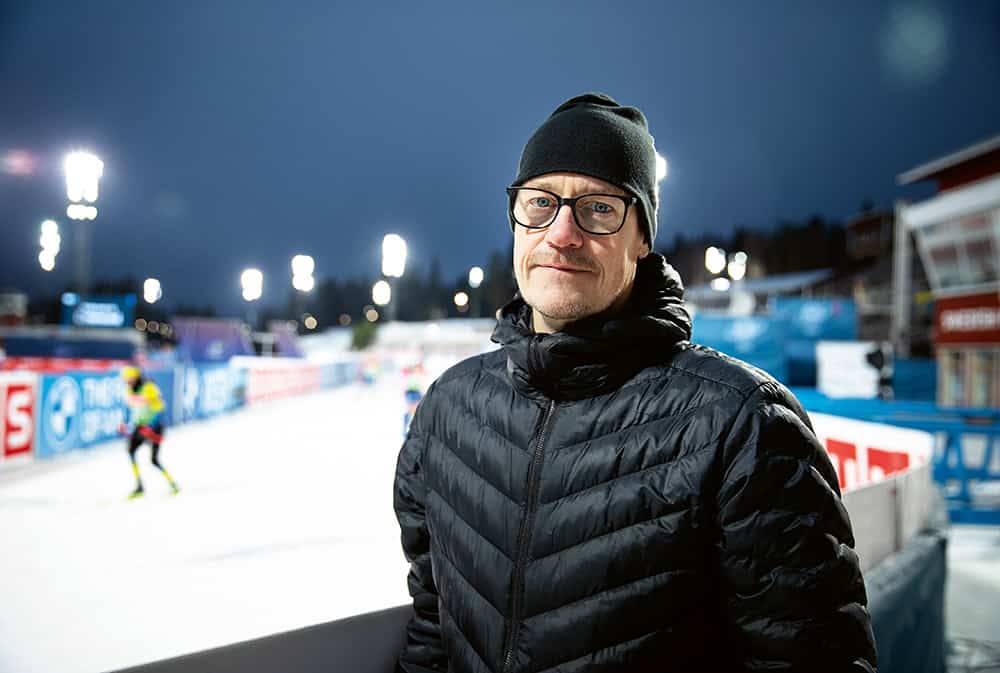
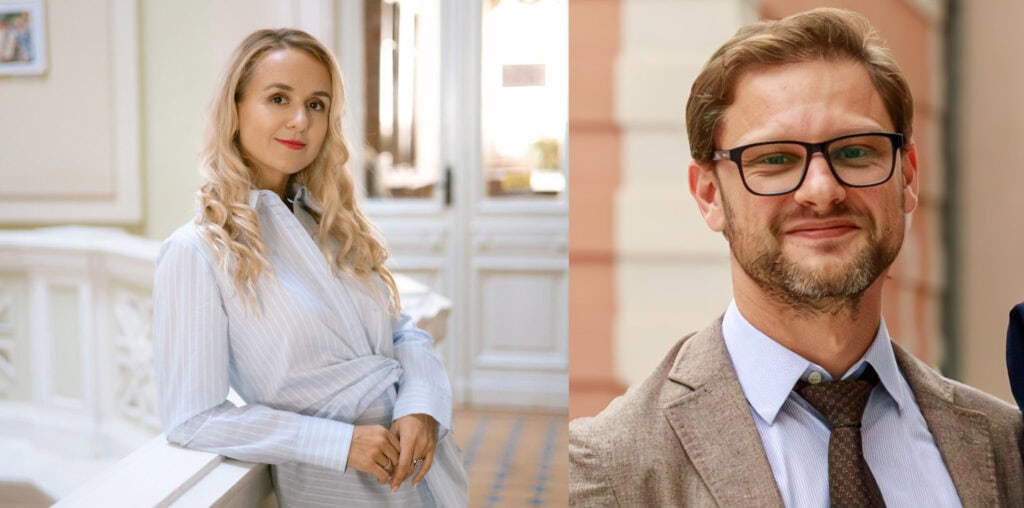
When Russia’s full-scale invasion of Ukraine began 24 February 2022, Yurii Orzikh was living with his wife and two children in Odesa, where he worked as a lawyer and researcher at the National University Odesa Law Academy. The family fled to Moldova, while Yurii Orzikh remained in Odesa. He contacted colleagues across Europe to seek opportunities to continue his research and teaching in another country.
“At Örebro University, there was a willingness to find quick solutions, with respect for the situation,” says Yurii Orzikh.
In October 2022, Yurii Orzikh moved to Sweden to conduct research at Örebro University. A few months later, his family followed. We conduct the interview in Swedish, and Yurii Orzikh apologises for his lack of fluency. He finds the language difficult, not least because the letters differ from the Cyrillic alphabet used in Ukrainian. Nevertheless, he now teaches tax law in Swedish – Swedish tax law.
“But it’s a big challenge for me. I have to prepare a lot for every lecture or seminar.”
A few times during the interview, Yurii Orzikh touches on the current difficulties in Ukraine, but interrupts himself. It’s difficult to talk about. Yurii’s mother, relatives, and friends are still in Ukraine.
“I haven’t been able to visit Ukraine for several years. I miss Ukraine, I miss my hometown, my homeland.”
“I miss Ukraine, I miss my hometown, my homeland.”
Yurii Orzikh
Since November, he has a permanent employment contract at Örebro University, where he is project manager for Train4EU, educating Ukrainian lawyers in EU law. The project is financed by the Swedish Institute, and is carried out in collaboration with several Ukrainian actors, including the National University Odesa Law Academy.
“It’s extremely important because Ukraine is moving closer to the EU. At the same time, we are seeing more cross-border cases due to migration. We want to build basic skills that can be disseminated throughout the Ukrainian legal system.”
The aim is to strengthen the legal certainty in cases involving Ukraine and the EU, with the hope that it will serve as a model for other EU candidate nations. There are many applications to participate, but implementation is challenging due to Russia’s continued attacks.
“We have to take that into account in our project,” says Yurii, explaining that many of the lectures are recorded so that they can be paused if necessary.
Teaching in war
Yurii Orzikh’s colleague Daria Minchenko is based in Odesa. She is an attorney, associate professor at the Department of Private Law at the National University Odesa Law Academy and head of the university’s international relations office.
“I never left. I never went anywhere, just for a few months or a few weeks. I always stayed in Odesa,” says Daria Minchenko.
Since Russia’s full-scale invasion, the reactions have gone through different stages, according to Daria Minchenko. Following the initial panic and disorientation, after a few months Ukrainians began to realise that life goes on, with work, research and studies. At the university in Odesa, there are a good number of shelters, which is an important reason why the university has been able to continue its activities.
“It is understandable that everybody is afraid, parents are afraid to send their children to university or to another city. But time passed, and the students also returned to the auditorium, which is a great achievement because it is very important that the students are still studying in their community, still talking to each other, seeing each other.”
But the obstacles for the university and its 10,000 students are many. It started with a curfew, then came the disruptions to infrastructure. There are many power outages, which affect internet access. And then there are the recurring air alerts and missiles.
“Whenever there is an air alert, we have to stop the classes, and we have to go to the shelters and wait until the air alert is over. This obviously disrupts the teaching process. Sometimes we can continue with the lectures downstairs, but sometimes it’s difficult.”
“Whenever there is an air alert, we have to stop the classes, and we have to go to the shelters and wait until the air alert is over. This obviously disrupts the teaching process.”
Daria Minchenko
She says that the disruptions to infrastructure and the sound of air alerts are a daily occurrence.
“Despite the fact that the anti-missile systems are working, you cannot be safe anywhere. Because the missiles attack buildings, they attack schools, they attack hospitals, they attack anything. You can be attacked anywhere and at any time, so you have to think of your security.”
The university has been attacked twice. The first attack caused minor damage to one of the dormitories.
“The other attack was on one of our campuses. Again, there was damage to the windows and to the roof. Some of the lecture rooms were damaged because of the broken windows, as well as the doors to the rooms. It was last year, but we managed to reconstruct it.”
According to Daria Minchenko, access to food and other supplies in Odesa is good, but inflation is high. Despite everything, she has never considered leaving, as it is important to her to continue contributing to the country’s survival – not least through the education of the younger generation.
“I don’t know how to explain it, but maybe each human being is different. We are different in our circumstances, in our financial state, in our family state… But we are also different mentally.”
Daria Minchenko keeps coming back to the fact that you never know how much a person can adapt to new situations.
“People can live even during the war. It’s strange to hear, especially for a person who never visited Ukraine or never visited a war country. But people can live there, surprisingly, but still, the country exists. We’ll go to the shops, we buy the cosmetics and stuff.”
When asked how Swedes can support Ukraine, Daria Minchenko says that first and foremost, everyone must remember that there is a war going on in Europe. Regarding researchers and universities, she requests opportunities for research cooperations and gives the collaboration with Örebro University as an example.
“Our research and our quality of education are actually quite good. And I think we can be of help. We have something to offer.”
When we talk about the future, Daria Minchenko wants to be realistic. She knows that the war will not end tomorrow. Like Yurii Orzikh, she sees an EU-membership as the way forward for Ukraine. Ukraine must adapt its laws to those of the EU, and Ukrainians must learn what an EU membership entails.
“Therefore, we adapted to the situation that we live in but still continue to work. Our government and our researchers are heavily working on EU integration.”
Foundation for recovery
Inna Mykhalchenko from the Trade Union of Education and Science Workers of Ukraine (TUESWU) explains via email that most appeals today concern urgent, practical issues in a time of war and martial law.
“Our primary focus is safeguarding wages and employment guarantees for teachers and researchers despite war and chronic underfunding. We consistently advocate for legally secured allowances and protections and resist efforts to shift financial burdens onto education workers.”
The union states that over 4,000 educational institutions have been damaged since the escalation of the war and refers to data from the Ministry of Education and Science of that 12 per cent of Ukraine’s researchers and university staff have been forced to relocate due to the war.
“Although international cooperation and integration into European programmes have increased, these positive developments do not offset the structural losses and daily operational challenges facing Ukrainian researchers.”
“We are sincerely grateful to our international colleagues for their solidarity.”
Ukraine’s higher education system is resilient, but is now operating at the edge of its capacity, according to the union. Research requiring physical access to research facilities and access to research equipment has been particularly affected.
“We are sincerely grateful to our international colleagues for their solidarity. In these years, it has been real support – not symbolic – helping Ukrainian educators and researchers endure.”
The union expresses its gratitude to those who continue their work under the extreme conditions that prevail, while calling for stronger investment in science as the foundation for Ukraine’s recovery.
“Our goal is simple but profound: to preserve people, protect the system, and ensure that Ukrainian education and research can recover and grow after the war.”