There is a constant sound of gunfire from the shooting area. A steady stream of skiers approaches, most with rifles on their backs. Some sprint, others slowly glide towards a lane, settle into position and aim. Then five muffled blasts at a steady pace. Hopefully, the black dots on the target will turn white when the shots are fired.
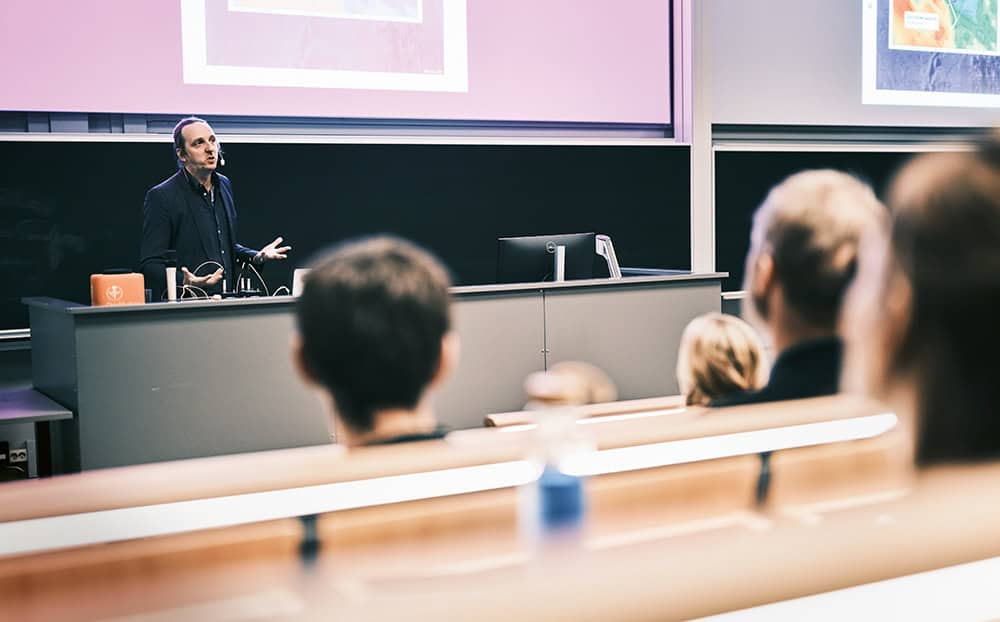
Slowing down your skiing the right amount just before shooting is an art in itself, explains Marko Laaksonen, a professor of sports science at Mid Sweden University. In the university’s communications, he is called a biathlon professor.
“It is not always an advantage to come in too slowly, purely physiologically, the heart’s pumping capacity. You feel that it starts to beat hard. That has a negative impact on your shooting, so it is better if your pulse is a little fast,” he says.
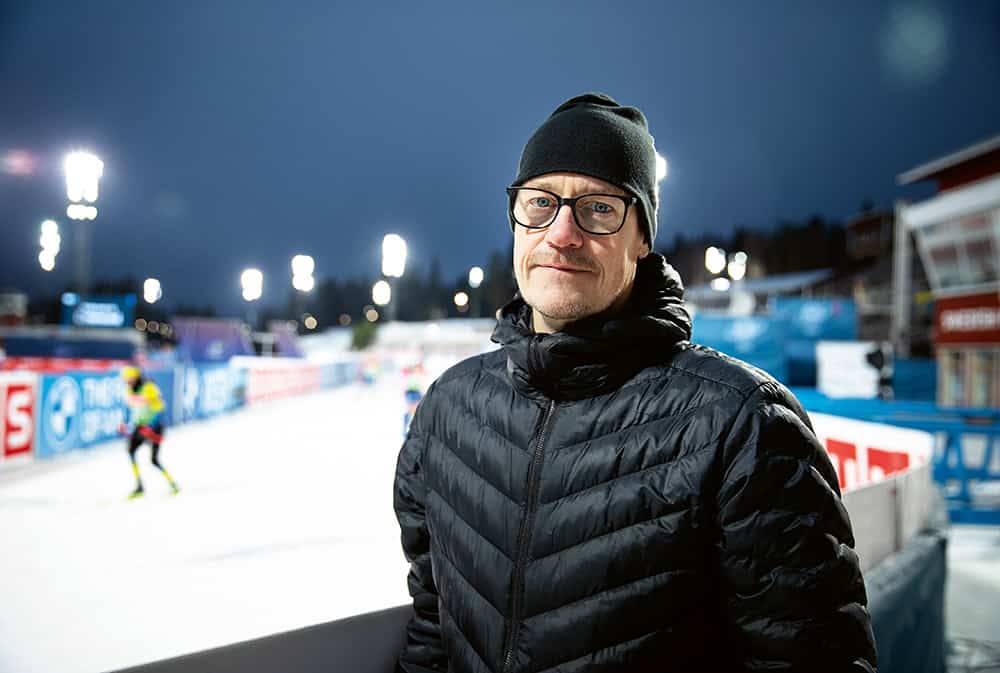
We are at the Biathlon World Cup event in Östersund. Today is a competition-free day, and we are watching official training for tomorrow’s pursuit race for women. At Östersunds skidstadion, Sweden’s national arena for biathlon, the temperature is a few degrees below zero and there is a layer of snow that has been saved from last winter. This year there has hardly been any snow yet, even though it is December. Several medal hopefuls aiming for the Milan and Cortina Winter Olympics ski past our photographer, lap after lap. Among them is Hanna Öberg, who at the time of writing has just won her first World Cup event in three years. Sebastian Samuelsson, third in yesterday’s men’s long-distance race, walks past us on foot, wearing the Swedish national team’s thick winter jacket. The biathlon professor greets him cheerfully in his characteristic Finnish accent and congratulates ”Sebbe” on his podium finish.
Marko Laaksonen bounces up and down gently in the grandstand as it is too cold to stand still. He rarely shoots these days and does not do much skiing either, only when it is nice weather. He looks over towards the shooting range and chuckles when asked about his own biathlon career. He mumbles something along the lines of “if you could call it a career…”
Growing up in Finland, no one in his working-class family participated in any sport at elite level. When he was 12, his father took him to biathlon training for the first time. In his youth, he was better at shooting than skiing and won a few Finnish championships. At the age of 26, he gave up competing and started coaching.
He also began his academic career, studying to be a sports physiologist. During his master’s studies in Jyväskylä, Finland, he contacted a research centre at Turku University Hospital to ask about the possibility of doing projects for his thesis. After completing his thesis, on the blood flow of the heart muscle, he was invited to apply for a PhD position in Turku, where he did a doctorate in clinical physiology and isotope medicine. The idea of doing research in the field of biathlon came later, when he moved to Östersund in 2005.
“I was very green at the time, but somewhere in my mind I felt that should be my focus. There are so many links to biathlon, cross-country skiing and performance here.”
He was the first person to be employed at the sports science programme in Östersund. He started three weeks after completing his doctorate in Finland. Just after his first couple of years as a biathlon coach.
“I had no experience of the Swedish university system,” he says. “I had never studied anything in Sweden.”

After six years, he saw there was a vacancy for a coaching job at the Swedish Biathlon Federation.
“Somewhere along the line, I also started thinking about whether this was really what I wanted to do. The opportunity came up and I thought, why not? I had experience of coaching.”
He knew people at the federation, applied and got the job. Then his coaching career took off. He spent five years as coach of first the Swedish women’s biathlon team and then the Finnish team. For the first four years, he took a leave of absence from Mid Sweden University. In the fifth year, his manager gave him an ultimatum, and he chose to resign from his position at the university.
A year later, he suddenly resigned from the Finnish national team.
“I had personal reasons at the time. I had two small children who lived, and still live, here in Östersund, and I had been working in Finland for two years. I felt that this was not good for the athletes, not good for the children and not good for myself. It was not working.”
He got his job at Mid Sweden University back. Since 2023, he has been a professor of sports science and deputy head of department.
“I have no desire to go back to coaching. Those days are gone. I enjoyed it immensely, but you have a schedule for the whole winter, and you travel around for weeks at a time. You get to know lots of people and feel like part of a family, and there is a nice atmosphere, but it is tough to spend so many days away and travelling.”
Marko Laaksonen …
… is 50 years old and a professor of sports science at Mid Sweden University. He grew up near Lahti in Finland and started with biathlon at the age of 12. He also enjoys playing music and folk dancing.
In the early 2010s, he coached the Swedish women’s biathlon team for three years and then the Finnish national team for two years. He is both a Finnish and Swedish citizen.
Laaksonen lives in Östersund with his two children. His wife lives outside Helsinki.
Back to the previous day’s men’s long-distance race. In the middle of the grandstand, there is a row of spectators in blue and yellow vests with the word Ponsi on the back. Someone is waving a Swedish flag on the end of a fishing rod. They are cheering on Martin Ponsiluoma, who was born and raised in Östersund. After a strong first lap and a flawless round of shooting, he comes in for the second bout and gets into position. A hit! The home crowd cheers. Two missed shots and as many disappointed groans from the crowd later, he takes off on his skis again. Ponsiluoma finishes in twenty-third place this time, but the crowd is pleased when Sebastian Samuelsson eventually crosses the finish line in third place.
Marko Laaksonen is not in the crowd to see the race. He prefers to watch on TV, he explains the next day as we sit in the rather empty cafeteria at Mid Sweden University.
“It is easier for me to concentrate, and it was the same when I was a coach. You are in the middle of everything that is going on, but nowadays the coaches use a tablet, where they have access to the times of all the skiers. Partly the same as used by the TV coverage. You can click between all the split times or see where the athletes are. You get a completely different understanding of the race.”
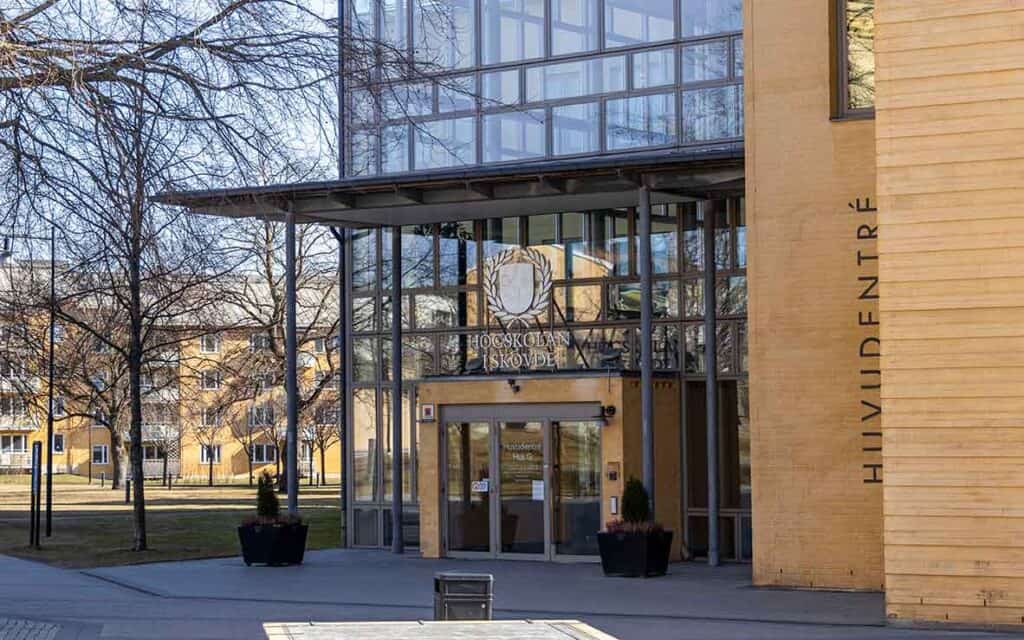
Östersund is, to an extent, a biathlon town – especially this week. Swedish Television commentator and former biathlon icon Björn Ferry is stopped outside his hotel in the centre of town by an elderly woman who wants to take a picture. Sweden’s national biathlon arena is here, and all the members of the national team live in the town. The fact that there is a skiing and biathlon university here, as it says on the sign outside Mid Sweden University’s D building where Marko Laaksonen has his office, says it all.
The office is at the National Winter Sports Research Centre, which started as an EU project and test lab for biathletes and cross-country skiers. Laaksonen shows us around the various treadmills, test labs and facilities for simulating high-altitude training. Mid Sweden University took over the running of it in 2007, and since then it has grown into a research centre and a meeting place for the national team cross-country skiers and biathletes who study here, train here, or both.
Nowadays, Laaksonen knows that he wants to be a researcher. When he came back after his coaching jobs, he realised that biathlon is an under-researched sport and he wants to change that. It is even under-researched compared with its constituent sports, cross-country skiing and rifle shooting. Biathlon is also a significantly smaller sport internationally than both, he says.
“When I was thinking about what I wanted to do on my return to academia, I had a pretty clear picture that this is an area that I really need to delve into. There are quite a few researchers with a background in biathlon, and they understand what research is needed and can translate it.”

One of his research projects was about how the rifle affects athletes’ performance in biathlon. A doctoral student he was supervising used as their starting point previous research that had looked at differences in skiing speed and in power in the use of the poles with and without a rifle on the athlete’s back. The study concluded that the rifle impacts body position.
“It is only 3.5 kilos that you have to carry, but it makes a difference. You hunch a bit. You cannot see it with the naked eye, but we can measure how it affects your skiing technique.”
Oddly enough, he notes, biathletes do quite little training with rifles on their backs. Elite level biathletes do somewhere around 700 hours a year of physical training, and they shoot for around 100 hours, he says.
“That is kind of what we were looking for with the studies, to shed light on and provide statistical values about how the rifle affects people’s skiing. And that you need to take this knowledge into account in your training. We do not know how much this is done in practice nowadays. We have not followed it up.”
In another study, published in spring 2025, Laaksonen and his colleague Glenn Björklund examined how biathletes’ performance in shooting and skiing in relays affects where they finish in races. They collected data on skiing times, shooting, penalty loops and shots fired from twenty relay teams over two seasons at a total of twelve World Cup events.
In individual races, small mistakes in either of the disciplines can have a direct impact on your final position, he says.
“In relay races, you get that impact times four, because there are four skiers involved. A poor performance in the first leg of the relay impacts those that come after.”
Their study found that there are some differences between genders. In women’s relays, the shooting in the second leg and the final leg had the greatest impact on the team’s final position. For men, the skiing on the last two legs had the biggest impact. In other words, in the case of women’s teams, it is important to put the best shooters on the second and last legs, while for men, the strongest skiers should take the last two legs.
“It should be borne in mind that we aggregated races and results over a couple of seasons in the study,” says Laaksonen. “So we can say that this is how it looks in the average relay. On the other hand, each race is unique. Different things happen. It might be more or less windy or there may be more snowfall.”
At the moment, he says, his role as deputy head of department takes up about half of his working time. Some of his research time is devoted to working for the Swedish Biathlon Federation, providing scientific support to the national team in the form of tests and analyses. He also supervises a PhD student in Finland, whose thesis focuses on the shooting component of biathlon, and two PhD students in Östersund, who are writing specifically about biathlon training.
However, not all his research is linked to biathlon. Building on his background in sports physiology, he is currently involved in a collaboration with two colleagues from his studies in Turku.
“I have been over there a few times, and we have started writing together again. It is a publication about the energy metabolism of the heart muscle during recovery from maximum workload, not linked to biathlon.”
So now he is commuting to Finland again, just as he did in the latter part of his coaching career. A year and a half ago, he got married. He lives in Östersund, where his children live with him every other week. His wife lives outside Helsinki, and the couple take turns commuting to each other.
There is a system, as Laaksonen puts it.
What is biathlon?
In the 18th century, the Norwegian army organised skiing competitions, including races in which participants skied with rifles and packs. At the 1924 Winter Olympics, an event called military patrol, combining skiing and shooting, was included for the first time, and in 1960 it made its Olympic debut under the name biathlon.
Biathlon has seven competition formats, of which four are individual races and three are relays. Competitors ski a course of between two and four kilometres, depending on the type of competition, shoot five shots and then ski the same loop again. The rifle must weigh at least 3.5 kilos, and the distance to the targets is 50 metres.