
In 2024, the European Commission published a proposal, in the form of a white paper, on which stakeholders and the general public were invited to comment. The issue at stake was a fundamental and radical change. Should the EU’s Horizon framework programme for research and innovation, which for 30 years has been exclusively for civil research, also be opened up for potential military applications?
The majority of the universities and academic organisations that responded said no. It would be better to continue to manage military research funding through the European Defence Fund. Otherwise, security regulations could undermine freedom, openness, international collaboration and quality in research. Among Swedish organisations expressing this view were the Swedish Research Council, the Royal Institute of Technology (KTH), the Karolinska Institute and Stockholm University.
Back in 2024, the question of opening up the framework programme to dual-use research, (see box), felt like a major issue. Two years later, it is less controversial, says Ellenor Devine, who heads Sweden’s Research and Innovation Office in Brussels on behalf of the Swedish Research Council.
Now, the question being discussed by the EU member states is rather to what extent purely military applications should be eligible for funding under the programme. Already this year, the current Horizon Europe programme will allow funding of start-ups with military applications through the European Innovation Council.
It remains to be seen what the next framework programme for 2028–2034 will look like. However, negotiations are focusing is on making dual use a fundamental principle of the programme. In the programme’s Pillar II, Global Challenges and European Industrial Competitiveness, one focus area being proposed is “resilience and security, defence industry and space”. This is linked to the new Competitiveness Fund, which is expected to have a major influence on the Horizon programme and where the development of dual-use technologies is one of the objectives.
Why this sudden major change?
One of the people who has been pushing for this is Sylvia Schwaag Serger. She is a professor of research policy at Lund University and has long been involved in the issue of responsible internationalisation. She is now also CEO of the Royal Swedish Academy of Engineering Sciences (IVA).
In spring 2025, an independent expert group within the European Commission published a report entitled Making the most of EU Research and Innovation Investments: Rethinking Dual Use. The main thrust of the report was that the EU’s framework programme should have a ”dual use by design” approach. Schwaag Serger is one of the experts behind the report.
The group’s recommendation represents a change of principle not only for the EU, but also for herself. She grew up in Germany. There, the experience of the Nazi regime’s use of research for its own purposes led universities to later ban military research by adopting a ”civil clause”.
“If you grew up in Germany in the 1970s and 1980s, you were made aware of Germany’s guilt and the question of how we could ensure that such a situation never occurs again,” she explains. “So I come from a peace movement that was impacted personally. It took me a long time to understand that these new technologies are different, and that the world is different.”

Sylvia Schwaag Serger
Professor of research policy at Lund University
She highlights the change in the international security situation since Russia’s invasion of Ukraine in 2022. Also in the years leading up to that, increased rivalry between the United States and China, as well as the coronavirus pandemic, had opened politicians’ eyes to the economic vulnerability of the EU.
This has led to new investments in research and innovation, but also to restrictions to protect important technological developments from leaks and espionage. This includes research in AI, quantum technology, semiconductors, biotechnology, space technology, advanced materials and energy-related technology.
“Through my work, I have come to understand that these disruptive technologies, by definition, have multiple purposes,” she says. “We have long believed and hoped that basic research is something that is fairly immune to military potential. But that is no longer the case. The gap between basic research and application has narrowed considerably, you can no longer say, ‘But I only do basic research, so I don’t need to think about such issues’.”
Even though the focus is often on technology and natural sciences, research within the field of psychology, for example, can also be used for military purposes. This is particularly true in the growing field of hybrid warfare, where campaigns to influence ideas and opinions play an important role.
“So I think we need to rethink many of our perceptions. One thing that has also been difficult for me to accept is that dual use is not only a problem, but it can also drive development forward.”
While the armed forces and the defence industry used to be the driving force behind civil technological innovation, they now find it difficult to keep up with the pace of civil innovation. In order to meet both military and economic security threats, there is therefore a pressing political interest in reducing the gap between civil and military research and innovation. More and more researchers and universities also want to contribute their knowledge.
Robert Egnell, Vice-chancellor of the Swedish Defence University, has observed these changes. “Five years ago, I could not really talk about this with vice-chancellors of civilian higher education institutions. It was a taboo subject. The concept of dual use was a kind of warning label, especially for nuclear technology. But now it has almost become a marketing label.”
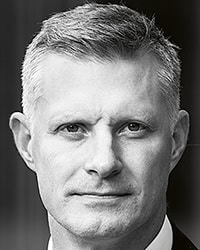
Robert Egnell
Vice-chancellor of the Swedish Defence University
Interest in collaborating with the Swedish Defence University has increased, as has the number of applicants for job vacancies.
“When war felt very far away from Sweden, the ethical issues were more difficult to grapple with. Of course, I and many others here asked ourselves, ‘What am I actually contributing knowledge to?’ and ‘Will this lead to something positive or not?’ Now, more people are asking the same ethical questions and coming to the same conclusion: that their contribution to military research is something that is to the benefit of Swedish security and democracy.”
In Sweden, civil research is funded through the state’s research budget, while military research is funded by the defence budget. Egnell would like to see both funding and innovation processes overlap more at the national level as well.
Across the street at the Royal Institute of Technology (KTH), however, Vice-chancellor Anders Söderholm maintains the view expressed by the Stockholm universities that civil and military research should remain clearly separate, and that synergies should instead be a matter for special programmes.
In an email to Universitetsläraren, he writes that there would otherwise be “significant consequences for the universities’ activities – not least when it comes to security classification, confidentiality, export controls and other regulations that would increase our administrative burden and potentially constrain the openness of our research environments”.
“KTH has already demonstrated that it is possible to contribute to defence and security-related research,” he continues, “for example through the European Defence Fund, while fulfilling requirements for transparency, publishability and the inclusion of international staff. That balance must continue to guide us.”

Anders Söderholm
Royal Institute of Technology (KTH), however, Vice-chancellor Anders Söderholm
It does not look like things will turn out the way he wants. And then, he points out, sufficient resources will be needed to deal with the resulting administrative burden.
The expert group of which Sylvia Schwaag Serger is a member also added several additional comments to accompany its recommendation. In order to address ethical issues and avoid jeopardising public confidence in research, for example, independent ethical bodies, research ethics training in dual use and military applications, public consultations and dialogue with civil society will be required.
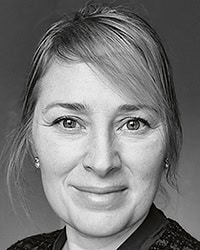
Ellenor Devine
The Swedish Research Council's office in Brussels
Ellenor Devine, at the Swedish Research Council’s office in Brussels, stresses the importance of addressing the concerns that exist. Will the regulatory burden for security-sensitive issues hamper research? Will funding for basic and civil research be eroded at the expense of research that can rapidly contribute to the EU’s military capabilities? Will researchers feel compelled to find a military application for their research in order to obtain funding? How will the high proportion of foreign researchers in Sweden be impacted by increased security requirements? How will the freedom, openness and international collaboration within research be affected?
“Monitoring and following up the framework programme will be a crucial protective mechanism to ensure that this turns out well. We will probably need to put a lot of work and resources into it,” she concludes.
Dual use – multiple meanings
According to EU export control regulations, dual use products are intended for civilian use, but they could be used for military purposes, cyber surveillance equipment or for the production of weapons of mass destruction and their delivery systems. If the intended use is military, the item is classified as military equipment instead.
In 2024, the European Commission described dual use as ”software and technology that has the potential to be used for both civil and military purposes”. In subsequent discussions regarding Horizon Europe, it has often been interpreted as products intended for both civil and military applications.
In certain fields of research, dual use may refer to research conducted for societal benefit or for peaceful purposes, but which could be misused for harmful or military purposes.