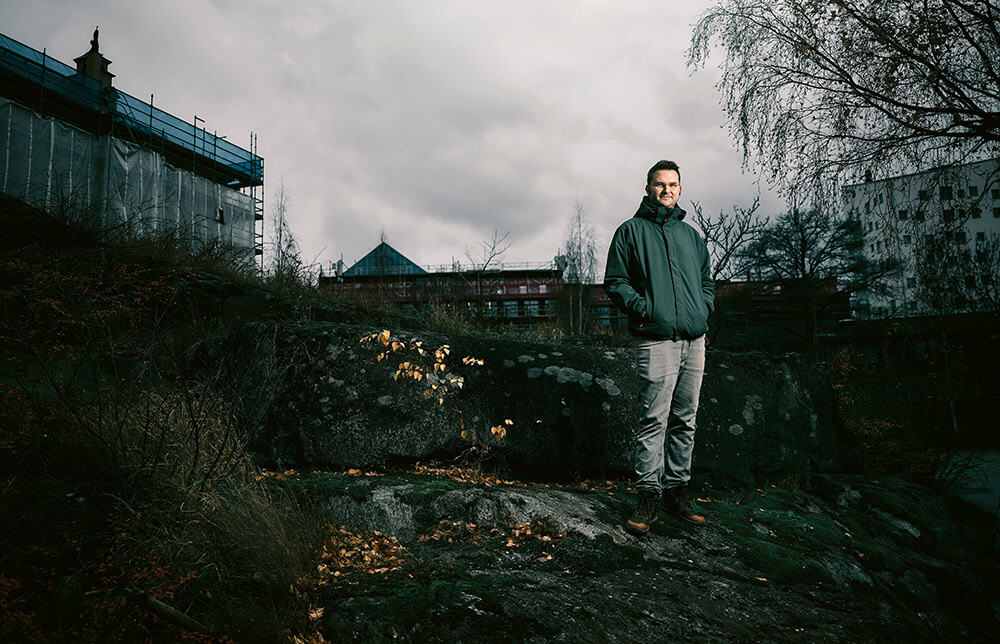
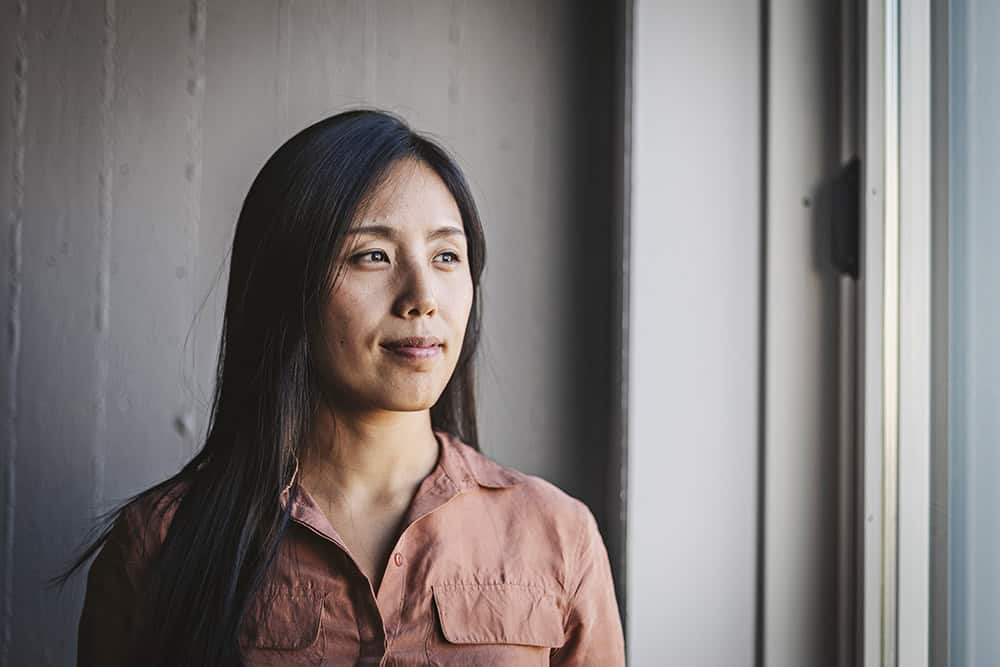
A study at the University of Gothenburg is currently examining the carbon footprint of the wealthiest people in society. It is looking at the possibility of introducing an income ceiling, explains Jayeon Lee, the researcher in social work who is running the study.
She realises how alien and, for that matter, out of touch with reality income caps can sound. As a policy instrument, it neither exists nor is it discussed. Lee sees her study as a starting point for a discussion on extreme wealth.
“There is a lot of talk about benefit caps, and that is an area of research that is close to my heart, but it is also time that we started talking about income caps.”
The roller skis leaning against the wall are not hers. Her husband borrowed them from a relative to train for the Vasaloppet skiing race last winter. But when the skis had been brought home on the train from Gothenburg to Skåne, where the family lives, it started snowing in southern Sweden. So now the wheeled planks have been sitting in her study for six months. She has not got around to returning them yet.
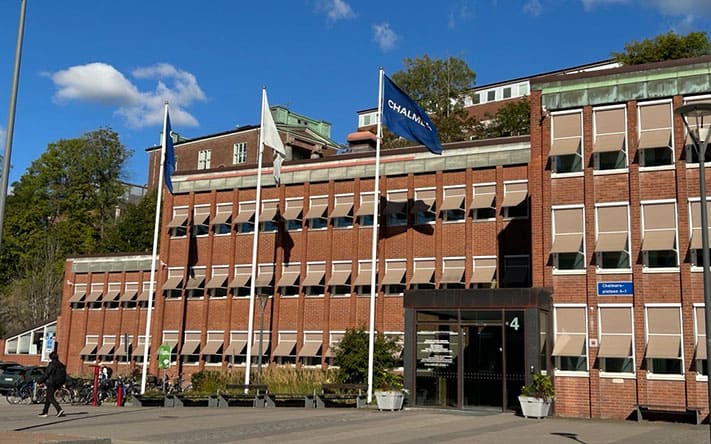
On this particular working day, Jayeon Lee read a PhD thesis on the morning train up to Gothenburg and then had a two-hour digital meeting. She had lunch with a colleague, gave a lecture to counselling students about health insurance in the afternoon and has just come from a book launch event. Full speed ahead as usual, she says almost breathlessly as she unlocks the door to the Department of Social Work. It is late afternoon, and there are not many people here on floor four.
“It is usually like this when I am in Gothenburg. I am here two days a week and have a lot booked in, with teaching and meetings.”
Lee has been commuting to her workplace from her farm outside Kävlinge in Skåne in the south of Sweden for the past two years. Commuting is a part – albeit a fairly small one – of her own carbon footprint. A footprint that is far too large, she says, describing a feeling of guilt.
Sixteen years ago, she was in her early twenties and made a life-changing decision. After studying social work back home in South Korea, she wanted to learn more about Nordic welfare. So she took a plane journey.
“I wanted to know everything about the famous Swedish welfare state and came here as a master’s student. Then I met my husband, started a family and didn’t think too much about what would happen when my parents got older and all those kinds of thing.”
So it is not the weekly commute that has the biggest impact on the climate for Jayeon Lee.
“I go to South Korea at least once every two years. And when I do not go there, my parents or my brother come here. So that has a big impact. It does not feel good at all.”
As a result, she has simply given up all other air travel, both private journeys and work trips. She takes the train to conferences in Europe and would never even think of attending one in Canada or Australia.
“Even though it would be the absolute best context I could imagine as a researcher, I would say no.”
At home on the farm, she keeps chickens and goats. The family grows food and is committed to self-sufficiency and permaculture, she says. From a plastic bag on her desk, she offers me yellow and red tomatoes that they have grown themselves.
“I try to live sustainably, but at the same time there are so many things you need to buy when you grow your own fruit and vegetables. We have a car with a trailer,” she sighs.
She has just one child, but not for climate reasons, she says jokingly.
“I have actually played that card when my daughter asks why she does not have any siblings. Told her that it is for climate reasons.”
Jayeon Lee describes herself as a welfare researcher. Her PhD thesis was about unemployment insurance, and she lectures on health insurance. After completing her doctorate, she gradually reached a realisation and began to think about poverty and why it has still not been eradicated. Not globally, not in Sweden.
“And it is linked to extreme wealth. So, instead of the climate crisis itself, my research focuses on how we can understand extreme wealth as a social problem. We have been talking about poverty and fighting poverty for decades, and we are not getting anywhere.”
A report by the charity Oxfam, covering the last 35 years, shows that the emissions caused by the richest people in Sweden have increased more than those of the average Swede. The richest 1 per cent have increased their emissions by 24 per cent, the richest 0.1 per cent by 44 per cent. In an interview by the public service broadcaster Swedish Radio, an Oxfam spokesperson describes how an ”ultra-rich” person emits as much in one year as an average Swede does in three decades. The organisation believes that wealth tax for the very rich, increased aviation tax and taxation of private aircraft and luxury yachts would therefore be a good idea.
For the record, Lee describes what is meant by an extremely wealthy person, based on the definition used in her research. Since there is no national wealth register to consult after Sweden abolished wealth tax in 2007, she uses earned income as the basis for her calculations.
“I think mainly in terms of distribution,” she explains.
“Different definitions are used in different contexts, but for the sake of simplicity, we can use the example of the one per centers, the richest one per cent of society. They earn around SEK 2.5 million a year. You might think that is not a lot, but when we look at earned income, that is where the line is drawn. Or you can think about the richest 0.1 per cent. Then the income is about 6 million.”
Researching extreme wealth
Jayeon Lee is a researcher in social work. She completed her PhD with a thesis on unemployment insurance and has researched the Swedish social insurance system.
She is currently studying extreme wealth from the perspective of it being a social problem. Specifically, the study focuses on the carbon footprint of the extremely rich and the idea of introducing an income ceiling on the one per cent of people who earn the most in society.
Research in social policy or welfare has not focused much on the richer end of the wealth distribution scale, she continues. As a welfare researcher, she is therefore trying to understand how extreme wealth can be seen as a social problem, or rather an ecosocial problem, whether it is possible to do anything about it and, if so, what.
“As long as the basic idea is that the economy should and can grow all the time, and as long as we think that we have to keep making the pie bigger and bigger to be able to address poverty, the very wealthiest are not a problem. They are regarded instead as a solution.”
She believes it is time to try a different approach.
“We now know more clearly that we have planetary boundaries that we should stay within. That makes it more important to distribute what already exists, to do something about those who live a life of plenty.”
All in all, it is a question of how the extremely rich impact the climate as individuals, but also as a collective. The more money you earn, the higher your consumption-based emissions in the form of travel or buying homes in different parts of the world, for example. This is simply luxury consumption, as Lee describes it. At the same time, the richest people also have a significant share of decision-making power over what resources are used for – what is to be produced and what people work with, she continues.
“Those with a lot of capital and who hold the various decision-making positions lock the rest of us in. If you think about continued investment in oil and gas, for example, money still flows into the fossil fuel industry every minute. We have not turned off the tap.”
It may seem strange that a social work researcher is studying this, she tells herself. But it is not a matter of measuring emissions. That work has already been done. The fact that the extremely rich cause more emissions than the not extremely rich is also well known. Instead, what she is looking at is what can be done.
And that is where income caps come in. With her current study, Jayeon Lee wants to capture public perception and understanding about emissions inequality. How people perceive the contribution of different income groups to climate change, what they think about the idea of income ceilings, and what they think is politically possible to implement. An interview study was conducted last spring, and this is now being followed up with a survey using a questionnaire.
In the pilot survey, respondents are asked to choose which of various income tax options they would prefer. Some options are more extreme than others, for example that income over SEK 2.5 million should be taxed in full. A slightly milder alternative is an equivalent taxation level on incomes above SEK 6 million, and in another, the line is drawn at SEK 10 million. Based on the results of a previous survey, she has found that about a quarter of the population thinks that an income ceiling of some sort is a good idea. A quarter has no strong opinion either way, while the rest regard it as generally a bad idea.
As the idea was alien to many respondents, she wants to find out in her new study whether people’s attitudes towards income ceilings change depending on what the extra tax money would be spent on. Are people more inclined to pay tax if the money is to be spent on military equipment or climate initiatives? Is there a certain level that most people in Sweden think is a good maximum income? Or is it simply the idea of an income limit itself that prompts resistance?
Jayeon Lee has not given much thought to what level she herself thinks would be a reasonable income ceiling.
“I asked all the interviewees that question, but actually not myself.”
She thinks for a moment.
“I will have to get back to you about that. But I would definitely set the limit at either 2.5 million or lower. I think 6 million is way too much.”
Since her research questions lean towards the left ideologically, it is natural to get questions about that from respondents, she says. As long as there is scope to discuss ideology, she sees no problem with a researcher having values.
Research agendas are obviously characterised by opinions and issues that the researcher is passionate about, she believes, as well as by the researcher’s values.
“But when I make statements as a researcher and when I communicate or pass on my research-based knowledge, I do not want to begin by saying that I stand to the left politically. Because that is not what is most important.”
There is no such thing as a researcher who is immune to discussions taking place in society, she explains.
“I am critical of researchers who want to portray themselves as completely neutral. I find that very strange. What kind of illusion of neutrality do they want to maintain?”
She describes academia as politicised, where knowledge is a political target. “So how can researchers keep themselves completely immune to all these discussions in society? I also think that anyone who has such an attitude is a bit out of touch with reality.”
Data collection in Jayeon Lee’s ongoing current will take place in December 2025 and January 2026.
Jayeon Lee…
… is a senior lecturer at the University of Gothenburg. She grew up in South Korea and came to Sweden 16 years ago to study.
She enjoys spending her free time outdoors and likes growing fruit and vegetables.
She sometimes goes to Thai boxing training, the only sport she has ever been interested in.
She lives on a farm outside Kävlinge in Skåne with her husband and children.