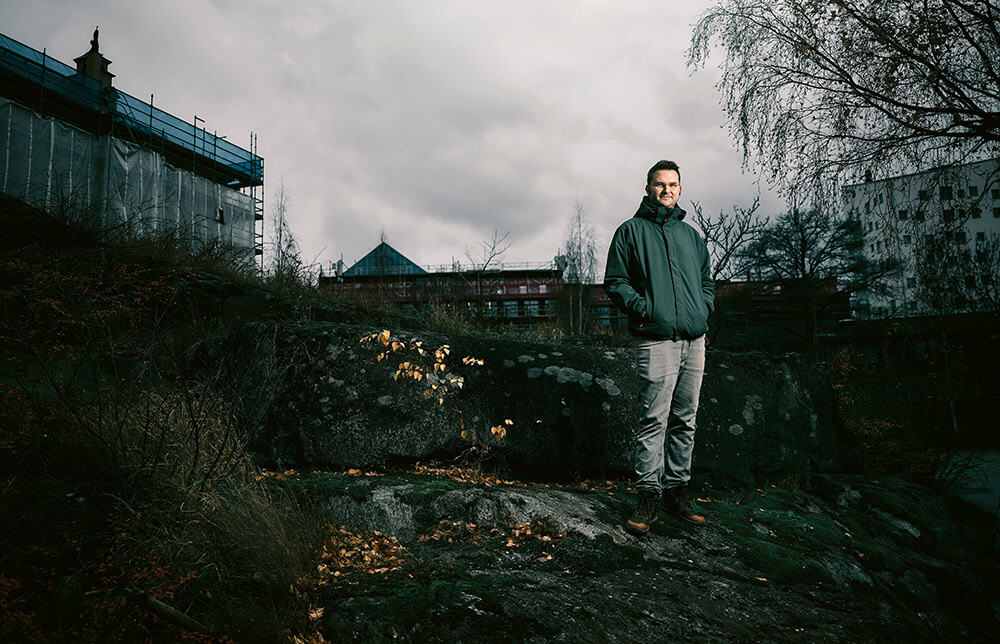
Mateusz Sosnowski shares a room with two colleagues at the Department of Philosophy at KTH Royal Institute of Technology, but today he is the only one here. He is a fire and risk management engineer at the Södertörn Fire Brigade Association and a researcher at KTH with external employment by the Brandforsk fundraising foundation.
He talks calmly, methodically and a lot. What he is doing as a doctoral student is using philosophy to investigate the underlying values that govern equal and satisfactory protection against accidents. The goal is to develop a basis for a more aware, reflective and fair fire risk management system, and the hope is that it will result in a broader debate and be translated into concrete recommendations for the emergency services.

The problem, or mess, as he puts it, lies in the organisation itself, where his research ”may not always be clear and justified, because people do not see the big picture”. Even if, for example, other heads of unit can see that there is a point to the research, it turns into a fight for resources where Mateusz Sosnowski, with his expertise and his time, could contribute more in other ways that are regarded as more urgent than his research.
The solution he has currently has funding for a licentiate thesis. He started in 2022 and has one year left with the current tripartite arrangement. His hope is that he will be able to extend his doctoral position or to find someone else to fund it. He says that part of the point of being an industry-employed doctoral student is to challenge yourself.
He adds quickly that the big challenge is to get enough uninterrupted time, and that he knew before he started that it would be ”messy”. He thanks his understanding manager for making it work anyway.
In the room at KTH, his desk, just inside the door, is tidy and just has a computer, two screens, some books and a few Lego figures on it. On a narrow shelf above it are framed photographs, also with a Lego theme in the form of Batman figures. A brown briefcase stands on the floor at his sandal-clad feet.
The agreement between the parties means that his employer, Södertörn Fire Brigade Association, agrees to release Sosnowski for 50 per cent of his working time.
“I have used that as cover, or shown them that ‘Wait a minute, lately I haven’t been getting my 50 per cent because I’ve been given a lot of other things to do’. That is perfectly fine, but you have to make up the time somewhere along the line, because the contract says that the 50 per cent is to be over the whole period,” he says.
In theory, he could devote 100 per cent of his time to research for two years, but that is not the intention. Instead, he has been able to show that he has only spent 40 per cent on it over three years. He told his manager, who said: ”Good, then we’ll free you up from everything else so that you get 80 per cent for the last year”.
Sosnowski is grateful for that, so now he is at KTH every day, but the organisation as a whole does not understand, does not want to, does not see the point of him not being a useful employee during this period.
“The point of this arrangement is that I will use my other 50 per cent to work on things connected with my research. There are a lot of potential synergies.”
He says he thinks holistically, is quick, analytical and highly productive, and that his research subject is strategic and has the potential to map out a future direction.
“It was therefore natural that the new, politically appointed director of the association was responsible for the research and acted as a sounding board. It worked really well at first. After a year or so, she seemed to have the view that ‘philosophy is difficult’ and that she didn’t understand the point of my research. Plus, there were no concrete results, and it was basically just costing money,” he says about her thoughts.
The agreement he and his employer signed contains a clause that means only he can terminate the contract. The arrangement means that the employer pays his salary and any travel allowances. Brandforsk pays all other expenses to the higher education institution, KTH, including for conferences and course literature. Brandforsk also pays KTH for supervision time and his office.
“It is a big investment over four years, and last year we had to save about SEK 30 million and there are further cost cutting requirements on the way. So I have to fight and justify what I am doing. But really, what I am doing is a win-win for the organisation.”
Universitetsläraren has contacted the organisation’s director, Cecilia Uneram, but was referred to the head of rescue services, Henrik Lindström, who took over as ”results supervisor” for Sosnowski’s research and acts as a sounding board when needed.
“As things stand now financially, I would say that our scope for having industry-employed doctoral students is quite narrow, quite poor. It was more feasible three years ago, when we signed this agreement,” says Lindström.
Like Mateusz Sosnowski, he is quick to point out that the research is a win-win situation no matter how you look at it. Both for the organisation and Sosnowski. Lindström speaks of a tasteful fusion between production and innovation and says that the research gets a boost through its clear connections to working life, while Södertörn Fire Brigade Association gets a research perspective on what it does. But he admits that he and Sosnowski’s immediate superior, who has been the driving force and really wanted this, did not ”fully anchor” the project in the organisation.
“We failed to visualise and describe what was going to happen. When things get tighter and times get tougher and you cut back a little here and a little there, then of course colleagues will wonder what is going on. So we have had to patch the communication gap that we perhaps created ourselves before we got started,” he explains.
Claudia Jiménez Guala, a legal officer at SULF, says that the situation for industry-employed doctoral students is difficult, because the arrangement is based on the fact that the agreements signed between the higher education institution and the employer do not always, or at least quite rarely, regulate the job security aspects, as she puts it.
“If you are enrolled as a doctoral student at a higher education institution, you have a place and you are entitled to that place until you have completed your doctorate. But an industry-employed doctoral student can usually be made redundant from their employment. This impacts the education that you have committed to at the higher education institution,”

Claudia Jiménez Guala
Legal officer at SULF
She describes this as industry-employed doctoral students being caught in a vacuum between two different systems: the labour law system and the education system. She also stresses that because they are regarded as employees, they cannot have stronger protections than those provided by the Employment Protection Act to other employees. Therefore, it is possible to make an industry-employed doctoral student redundant, which is not the case for Mateusz Sosnowski, for example.
Thomas Eliasson had just returned from Canada, where he was an exchange student at the Department of Animal and Poultry Science at the University of Guelph, Ontario. He was planning to complete his master’s thesis and heard about a collaboration between the Swedish University of Agricultural Sciences (SLU) and the Swedish dairy company Norrmejerier. The focus would be on the entire chain, from farm to cheese. He was attracted by the idea that it was a doctoral project with external employment, LivsID, a government assignment, with a group of doctoral students who would stick together through the whole journey, as well as by being able to do research full-time.
In April 2018, he leapt into the project and started at Norrmejerier in Umeå. The aim was to find out which bacteria contribute to the flavour and structure of cheese. All through the summer, he was out in the field, from Lomma in the south to Umeå in the north, or in the lab collecting and then analysing samples.
“In the autumn, I felt it was going well. I was alternating between spending time at Norrmejerier and at SLU where I could work with my research. At the dairy, I did some side projects and got to know the company. We realised quite quickly that I needed to have full focus on the project. It was my boss there who felt that I should put 100 per cent of my focus on the project, because technically I was working for them,” he says, explaining that the project and its results were something that Norrmejerier could make use of.
The first setback came when he and the others involved realised that they would have to redo the study they had conducted in summer 2018. They had too little data, and suddenly the whole project was a year behind schedule. So they collected grass samples all summer again, made silage and conducted analysis. But the silage has to be stored for a hundred days before you can touch it, so grass that was collected at the end of the 2019 season wasn’t ready until around Christmas that year.
In 2020, Eliasson was still based in Uppsala, but travelled up to Umeå and to Norrmejerier regularly. That spring it was decided that it was time to start writing articles, but all the time was spent planning the cattle feeding trial and once again collecting grass and making silage. Then there was analysis, sampling and waiting for the cheeses to mature. It went on like that until 2023.
He was caught in the middle, with too little time to prepare to become a specialist at Norrmejerier or to be out presenting his research as much as he wanted. In spite of the situation, he managed to publish two articles, write a doctoral thesis and present his work at a local conference at SLU in Uppsala.
During the project, there were insufficient resources, and he had to do things that doctoral students are not expected to do, such as casting thousands of agar plates or mixing several hundred litres of various solutions. He was supposed to finish in April 2023, but it took until September the following year.
“I had two children during the project, and both my mum and dad got cancer. My dad passed away first, and then my mum a month after I finished my doctorate. All of that contributed to my project being extended.”
He claims that his employer, Norrmejerier, made a big deal about him taking so much parental leave, taking holiday leave in the summer and taking care of his father.
“Those are discussions that you should not have to have, and sometime in 2024 Norrmejerier ran out of money for the project. Then they said: ‘Now we have extended it enough; it’s time for you to finish it’. I tried, but I hit the wall.”
When Universitetsläraren talks to Eliasson’s manager and supervisor at Norrmejerier, Karin Hallin Saedén, she says she does not think they could have done anything differently.
“Giving him even more time would have been difficult from a company perspective. Twenty per cent of your time should be spent at the company doing things other than your doctoral project, and we did not insist on him doing that one year. He needed to focus on the project. I wanted him to finish. But there are limits.”
She thinks that Eliasson received a lot of support from them and from SLU, and she believes that Norrmejerier helped as much as they could. She also points out that all doctoral students face a lot of pressure at the end of their thesis work.
“Sometimes, even in a company, you have to say that now it is good enough. I would compare this with all the other PhD students we have had. It is always tough at the end, but he always had someone he could talk to when things got difficult, so I think we were there for him.”
What is the difference between doctoral and industry-employed doctoral student contracts?
A doctoral contract is entirely focused on academic research and includes departmental duties, such as teaching.
An industry-employed doctoral student contract means that the doctoral student combines their research with work for a company or other organisation. The doctoral student is employed by or works closely with a non-university organisation to resolve some kind of practical problem or address questions through research.
In the last month, Eliasson worked late into the night and was up early in the morning.
“That has left its mark. I still suffer from brain fog. Some days I get nothing done.”
He says that when it is at its worst, he just sits and stares at the wall. Now things are moving in the right direction, but when he took up a global role at the dairy company Arla in Umeå, where he has been working since January 2025, it was tough. He wanted so badly to do a good job, wanted so much to show what he could do, but he did not have the energy. He almost gave up.
Eliasson believes that the project should have been slowed down in time and that Norrmejerier should have added a month or two at the end. He also wishes he had received more support from SLU. In the wake of the pandemic, there was an opportunity to extend the project period, but no such application was ever submitted. That might have solved the funding issue. Instead, he was offered an extension by Norrmejerier, but unpaid.
His main supervisor then stepped in and paid his salary for the last few months, with the help of a grant.
“When I had finished my PhD and I started working at Norrmejerier, I did not enjoy it. I decided I should do something completely different, so I resigned.”

Let us rewind to 2021, when Thomas Eliasson and his wife found a farm in Vindeln, outside Umeå,. She had almost completed her doctorate and was able to finish the last part at SLU in Umeå. An important piece of the puzzle when they decided to move was that he had secure employment at Norrmejerier.
“I had a dream of contributing to agriculture in northern Sweden. It did not quite work out that way. Now I am contributing to northern European agriculture,” says Thomas Eliasson with a laugh, referring to his job as a milk quality expert at Arla.
He feels that Norrmejerier was not interested in his expertise. He felt overlooked, and he notes that many of his industry-employed doctoral colleagues were frustrated, although his case was one of the more extreme.
“It is not really clear what the priority is when it comes to industry-employed doctoral students. Is it that the company should be able to train someone basically for free? Or is it that the company should conduct research together with the university and train people at the same time?”
He has no answers to his own questions, but he would like to see clearer guidelines for how projects with industry-employed doctoral students should be run. His impression is that there is no active discussion about this. He and his doctoral colleagues talked about it when they met, of course, but there was complete silence when it came to the people who actually have a say, such as the managers at the companies or the academic supervisors.
“SLU was very poorly informed about what was happening, and when problems occurred, they did not really have a mandate to do anything. It was as if contracts meant nothing.”
Eliasson carried a feeling of inadequacy with him for most of his doctoral studies, he says thoughtfully. He was sitting on two chairs and felt that no one could help him. In the end, he did get help from SULF.
“If I had not had that support, I would probably have signed some crazy contract.”
Dispute in the Labour Court
Universitetsläraren has previously written about an industry-employed doctoral student who was made redundant due to lack of work and then sued the employer.
After SULF brought the dispute in the Labour Court, the parties reached an agreement whereby the doctoral student received 22 months’ salary.
The agreement did not concern the doctoral student’s funding and only regulated the employment relationship.