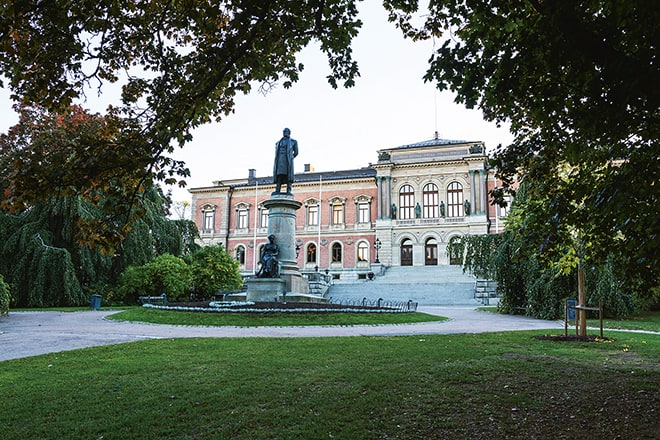

Generative AI tools such as ChatGPT became widely available in autumn 2022. In February the following year, a student at Uppsala University admitted using ChatGPT to help with written assignments. It was the first Swedish case where a student received a warning for cheating with the help of AI, something which Universitetsläraren wrote about at the time.
Since then, a survey by Universitetsläraren of 33 universities and colleges shows, 770 cases of AI cheating have resulted in suspension. So far this year, students have been suspended for cheating related to some form of unauthorised use of AI tools in 467 cases, up from 207 last year. In addition, 75 warnings have been issued since the beginning of 2023.
At Stockholm University, students have been suspended in 77 cases, the highest number of any higher education institution. Additionally, the university has issued 24 warnings in the past three years.
“We are Sweden’s largest higher education institution for first- and second-cycle courses and programmes, so from that perspective we would be expected to be at the top of the list,” says Clas Hättestrand, chair of the disciplinary committee at Stockholm University.
“We have also been quite active in raising awareness among our teachers about the risk of cheating through the use of AI. It is possible that this has also had an effect.”
He describes how staff are actively informed about AI use. Guides, courses and workshops have also been developed.
“I have noticed that there is a great deal of interest in these issues and a willingness to discuss them. This applies to both the positive aspects of AI, which, for example, our higher education pedagogy unit works with, but also, of course, how we can work with examination methods,” he says.
Linköping University has had 63 cases of students being suspended for unauthorised use of AI tools in the past three years, with 47 of those occurring in 2025. In addition, 12 warnings have been issued.
The increase in suspensions over time is partly due to more and more students using AI in unauthorised ways, according to Karin Axelsson, pro-vice-chancellor at the university.
“I also think that teachers have become better at explaining what is and is not allowed,” she adds.
The introduction of generative AI in higher education, she believes, has also made university teachers more aware of cheating, and perhaps more likely to report it.
“As a teacher, you read and think about submitted texts in a different way than you did before.”
She is not surprised that the curve for suspended students is trending upwards.
“We are doing quite a lot right now at the university that should mean that it, (the curve, editor’s note), will eventually not only level out but also turn downwards. The current level should be a hump. The vice-chancellor has just announced an action plan to AI-proof all our education.”
Under this action plan, examination methods in all courses and programmes are to be reviewed. SEK 4 million per year has also been earmarked for ‘AI ambassadors’ at each department over the next two years.
Axelsson emphasises that this is not just an action plan to curb cheating.
“We are going to assess the examination methods and procedures for all our courses so that we do not go down the same old paths, for example, with a home exam that has looked the same for years. But we are looking just as much, or perhaps even more, at how we may need to change course content so that we prepare students for a future working life where they can expect generative AI to be used routinely,” she says.
75…
…warnings have been issued in the past three years at the 33 HE institutions in our survey.
770…
…cases of AI cheating have resulted in suspension since the beginning of 2023.
467…
…cases of suspension have occurred so far this year.
Universitetsläraren also asked higher education institutions whether their examination formats have changed as a result of AI, and if so, how. Of the 32 universities and colleges that responded to these questions, 27 reported that their methods and procedures have changed to some extent. At some others, discussions on examination methods are ongoing.
Beckmans College of Design, Konstfack, the Royal Institute of Art, the Royal College of Music and Stockholm University of the Arts are the only higher education institutions that have not reported any cases of AI-related cheating.
According to Maria Hedman Hvitfeldt, a head of department at Stockholm University of the Arts, there may be various reasons why the artistic higher education institutions have not uncovered any cases of AI cheating.
“We must work instead to ensure that students acquire knowledge about AI and use it in a way that benefits the arts and the development of one’s artistry,” she says.
However, non-artistic higher education institutions can probably learn from the artistic institutions’ examination procedures, believes Clas Hättestrand at Stockholm University.
“Definitely, I’m convinced of that. We are working quite actively on these issues within the Association of Swedish Higher Education Institutions (SUHF), with quite a lot of learning shared among the higher education institutions, and we have been holding conferences and workshops at that level as well.”
Maria Hedman Hvitfeldt points out that it is difficult to compare the different types of higher education institution with each other in terms of examinations.
“The law programme works a lot with cases. That is the equivalent of what we do, I would say. But then you have to know the statute book too. We don’t really have anything that corresponds to that.”
She believes it is possible that the practical examination elements of higher education institutions in the arts could inspire non-arts institutions.
“We have very close contact with our students, and you might not be able to have that in the same way at another higher education institution. Practical tests could be an alternative, if they do not already have them. They show clearly see what a student knows and does not know, what they can and cannot do.”
Suspension or warning
According to the Higher Education Ordinance, a student who has used unauthorised aids or attempted to mislead in an examination or test can be suspended for a maximum of six months. Such decisions are made by the HE institution’s disciplinary board.
In other cases, the vice-chancellor can issue a warning. This means that the student may continue to participate in examinations and education, but receives a reprimand. A warning can be appealed to the disciplinary board.