
At the turn of the year, changes were made to pension and retirement rules, meaning more people are expected to work for longer. However, research shows that older job seekers are often filtered out in the early stages of recruitment processes.
Academia is no exception. Even though several universities, such as Gothenburg, Karlstad and Lund, are actively working to combat ageism, positions are primarily going to younger applicants. A review by Universitetsläraren shows that the most common age for new employees is between 25 and 44. After the age of 45, the path to a new job grows steeper, and for those over 55, it is even more difficult.
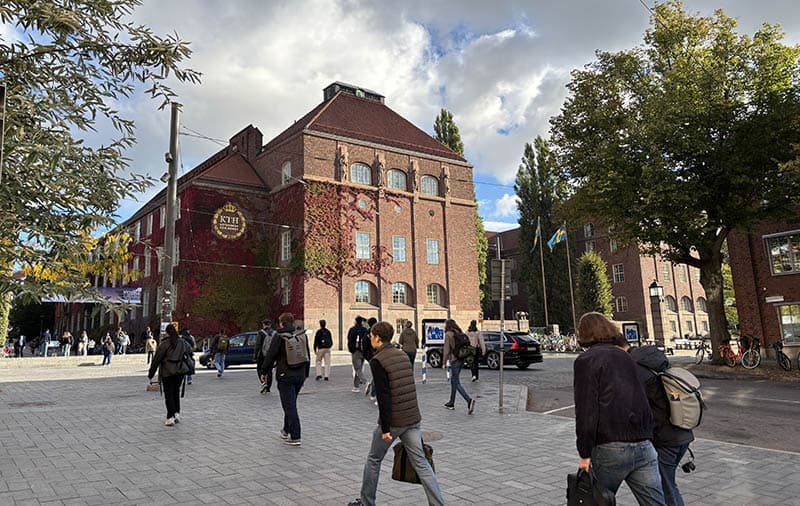
Technical higher education institutions recruit the youngest employees, with nine out of ten new employees under the age of 50. However, Anders Jansen, an HR controller at the Human Resources Department at the Royal Institute of Technology (KTH), believes that age is not a decisive factor in recruitment.
“We advertise many doctoral, postdoctoral, student assistant and research engineer positions, which naturally is reflected in the age structure of applicants and new employees,” he explains.
The average age of new KTH employees in teaching and research is slightly higher than for other staff appointments. Only a small number of the new teachers and researchers are over 60.
At the University of Gothenburg, almost seven out of ten people recently employed in teaching and research positions are under 45, while 11 per cent are over 55. Ralph Heiefort, a development manager at the Human Resources Department, is surprised by the figures.
”We have not set a goal to lower the average age of our staff,” he says. “All our recruitment is based on competence and qualifications, and age should not be a factor.”
Anna Jutterdal, Head of Human Resources at Stockholm University, comments on the statistics by email: “Age is not something that we discuss when recruiting. As a state agency, we hire on the basis of qualifications and competence. I cannot confirm that we hire few people over the age of 50. And if that were the case, I do not have a simple explanation,”
The Swedish Defence University is bucking the trend, with almost half of its new employees over the age of 50.
“Many types of position at the Swedish Defence University often require qualified professional experience, which can be a factor that coincides with longer professional experience,” writes Monica Welmer, Head of Human Resources at the university, in an email.
Stockholm University of the Arts also recruits slightly older employees than the average, with 90 per cent of the newly employed university teachers and researchers between the ages of 35 and 54. However, none of the positions filled in that category in the past year went to a person over 55.
Anders Eriksson, Director of Human Resources at Stockholm University of the Arts, cannot recall ever hearing a discussion about an applicant being “too old or too young” when discussing employment.
“We have clear recruitment processes based on merits and skills. It is pedagogical and artistic competence that counts,” he says.
Senior researcher Ingmar Skoog, a professor at the University of Gothenburg, believes that higher education institutions should be able to provide better explanations for their recruitment decisions. He believes that it is their responsibility to monitor for any potential discrimination. “The question that arises is whether there is structural discrimination that employers are unaware of.”
Seven higher education institutions were not able to provide the information requested by Universitetsläraren. Skoog finds it odd that they have not been able to provide the data, which he believes should be in their own interest.
“Universities should be able to explain what underlies their recruitment practices, why things look the way they do. If meritocracy does not apply at universities, then where would it?” he asks.
According to the legislation that governs employment in the state sector, skills and qualifications should be the deciding factors, and no one should be excluded on the basis of age. The government has also recently tasked the Swedish Agency for Government Employers with monitoring how state agencies are working to enable people to work for longer. The assignment includes reporting on age distribution among state sector employees, with a particular focus on older staff.
“It is important that the state sets a good example as an employer by utilising the competence of its employees, regardless of age, and by creating conditions for a longer working life,” writes the Ministry of Employment in a press release.
A few years ago, Ingmar Skoog was a member of the Delegation for Senior Labour, which was set up to investigate ways to combat age discrimination and create opportunities to better utilise the skills of older people.
“We found that the state sector is the worst at utilising older workers, and that includes universities,” he says. “That is the complete opposite of what politicians say they want,”
The result of shutting out older people is that universities and colleges risk losing invaluable knowledge and supervision experience, something that Skoog thinks is a worrying sign.
“The question is what the impact is on Swedish research if certain groups are discriminated against.”